Cannibal Holocaust

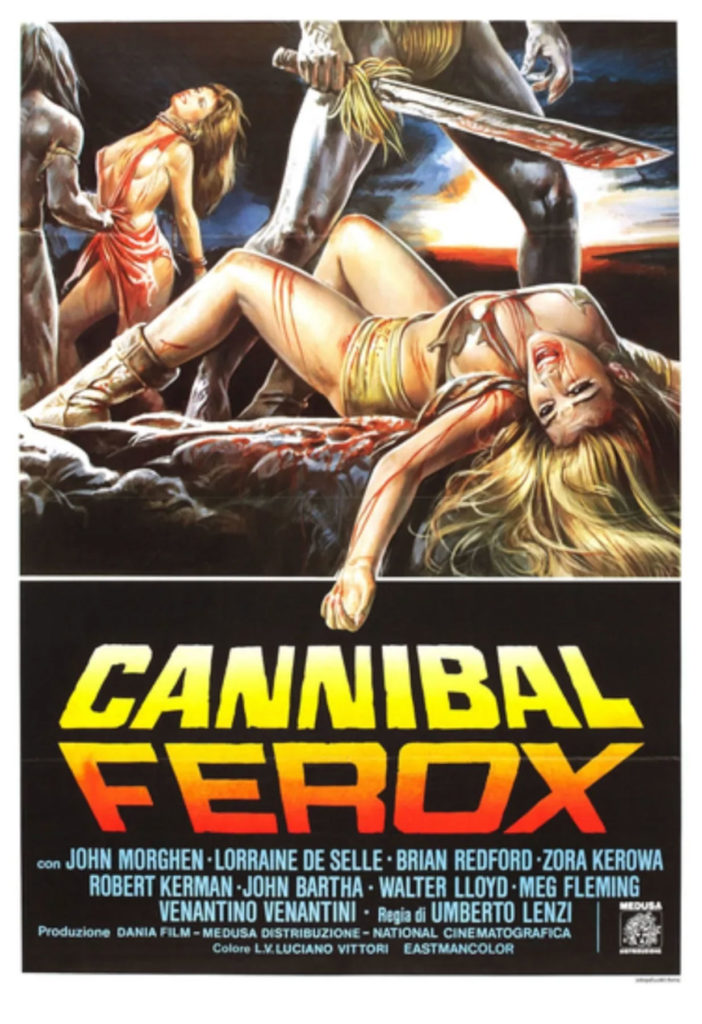
This one’s a tough watch, folks. Cannibal Holocaust, from director Ruggero Deodato, was not the first Italian cannibal horror flick, but it is the most notorious. It’s the most disgusting. It’s the most disturbing. It’s the most alarming. It’s the most guilt-ridden for the viewer. Its portrayal of death was realistic enough that Deodato was briefly charged with murder upon the film’s release in Italy. It has earned every bit of its reputation. It’s also one hell of a movie.

Cannibal Holocaust tells the story of four NYU film students who head to the Amazon jungle in Colombia to shoot a documentary about local tribes that practice ritual cannibalism. When they go missing, a professor of anthropology, Harold Monroe (Robert Kerman), heads to the jungle to see if he can find out what happened. He’s joined by guides Chaco (Salvatore Basile), and Miguel (possibly Ricardo Fuentes — the credits don’t say and the internet is divided). Continue reading “Cannibal Holocaust”

Deadly Manor

The late 1970s into the early ’90s was one of horror cinema’s golden ages, and that success was built on the slasher flick. The names of villains are iconic. Michael Myers. Jason Voorhees. Freddy Krueger. Chucky. But, most slasher flicks didn’t have larger than life villains such as these. The grist mill was running too hard and fast. The VHS boxes were piling up in the back of the video store. The mantra was to take the familiar slasher tropes, throw some new, young faces into the mix, and let loose. Most slashers ended up being one-offs, with no hope for a sequel. Some, like Maniac or My Bloody Valentine, became iconic in their own right. Most were crap, though. Like Deadly Manor. Continue reading “Deadly Manor”

Massacre in Dinosaur Valley, aka Nudo e selvaggio

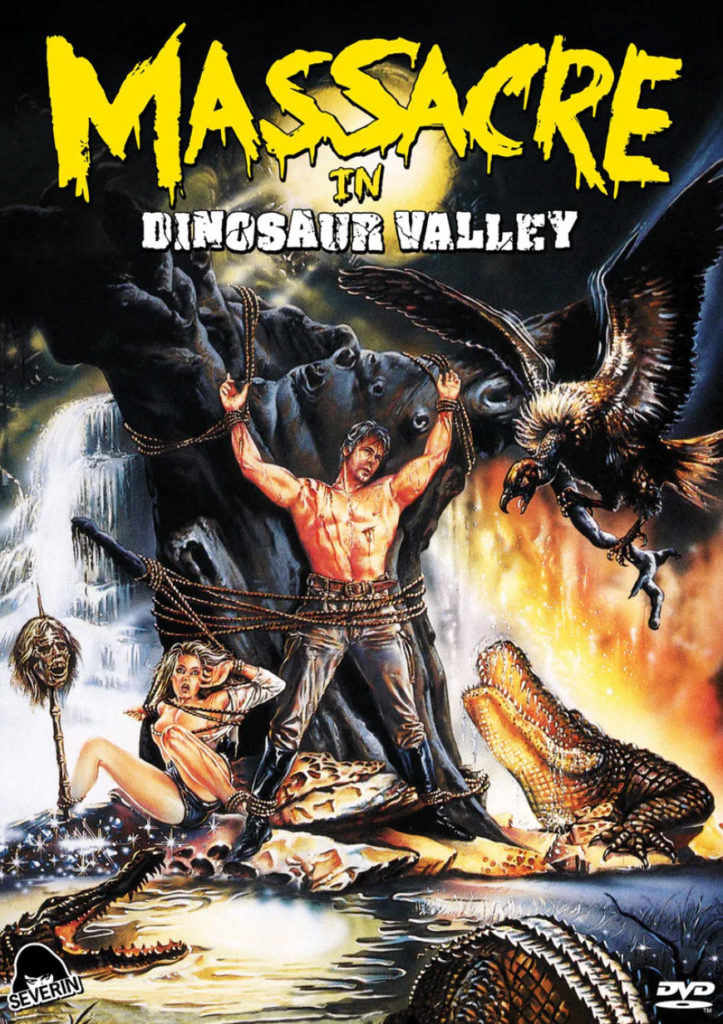
Massacre in Dinosaur Valley movie posterThere are good Italian cannibal horror flicks, and there are bad Italian cannibal horror flicks. Besides the plot elements they all share and steal from one another, the other thing they have in common is that they are prime exploitation cinema. Massacre in Dinosaur Valley is one of the more exploitative of the bunch, and it has nothing to do with animal slaughter and mutilation, or graphic depictions of bodily injury. This flick is about the nudity. It’s right there in the Italian title of the movie.

“Nudo e selvaggio” translates into English as, “Naked and wild.” The English-language distributors must not have thought much about that title, which would probably have frightened off more than a few theater owners back when it was released, so they titled the film Massacre in Dinosaur Valley. It’s just as descriptive and accurate as the Italian title. There is a massacre, and it happens in some place called Dinosaur Valley, but I have to admit that, going into this film blind, I was disappointed that there weren’t any dinosaurs. Meanwhile, had the film just been called Naked and Wild, my expectations would have been satiated. Anyway…

From 1985, Massacre in Dinosaur Valley is a joint Italian/Brazilian production, written and directed by Michele Massimo Tarantini, with some uncredited script work by prolific screenwriter Dardano Sacchetti. The film stars Michael Sopkiw as Kevin Hall, a mercenary paleontologist who roams all over South America in search of fossils. Continue reading “Massacre in Dinosaur Valley, aka Nudo e selvaggio”

The Dead Next Door

Many creative people hail from the rusted industrial corpse of Akron, Ohio. Some of them even get famous. Musicians, mostly. But, when it comes to filmmakers, there is one name, and one name, only, associated with Akron. And it’s not Jim Jarmusch, despite what the list of people from Akron on Wikipedia would suggest. This filmmaker has not only made more movies than Jarmusch (who I like as a filmmaker, by the way), but made many of them in his good ole hometown. His name is J.R. Bookwalter.

His first feature, released in 1989, is the classic low-budget, ultra-gory Dead Next Door. Produced, written, and directed by Bookwalter, production began in the summer of 1985 when Bookwalter pitched Sam Raimi on the film. Raimi, gaining an executive producer credit, agreed to pony up the cash, and shooting began in spring of 1986 after some fits and starts. More problems cropped up, as often happens in productions like this, but the majority of the film was in the can by that autumn. 1987 and 1988 were for reshoots, more tinkering, and editing. Finally, sweet release on video in November of 1989. That’s a labor of love, folks. Continue reading “The Dead Next Door”

Panic, aka Bakterion, aka Monster of Blood

Horror flicks from Italy are some of the most beloved films the genre has to offer. They have a style that is instantly recognizable. Names of auteurs — Argento, Bava, et al — are known and discussed with reverence by fans. But, like film industries all over the planet, there is a fair amount of chaff among the wheat. Case in point: Panic, a bottom-feeding horror flick released under a number of titles, including as an entry in the confusing Zombi series of films.

From screenwriters Victor Andrés Catena and Jaime Comas Gil, and directed by Tonino Ricci, Panic is quite a departure from other films featured in this year’s Horrorshow. It’s not gothic, nor is it a descendant of giallo. There are no supernatural elements and no lip service to the Catholic Church. If anything, this film, in tone and style, is reminiscent of 1950s and early 1960s British science fiction, along the lines of the Quatermass films. In other words, it’s talky. Continue reading “Panic, aka Bakterion, aka Monster of Blood”

Forbidden World

Roger Corman has caught a lot of heat in these pages for being a cheapskate. The man was, and still is, ruthless in his pursuit of efficiency in his productions. This has often been a detriment to his films. As a filmmaker, Corman could make better movies if he loosened the purse strings ever so slightly, but he always seems to err on the side of budget over art. That said, the man’s contributions to cinema, and shitty movies, cannot be overstated. Forbidden World, a Corman production from 1982, encapsulates just about everything that makes a movie shitty, and is an excellent example of the Corman style. Continue reading “Forbidden World”

Absurd, aka Rosso sangue

As often happens in film, a project begins with one intention in mind, and ends up being something else. Such is the case with Absurd, one of eight films released by prolific filmmaker Joe D’Amato in 1981. Like with Anthropophagus in 1980, this is the only one of the year that wasn’t smut.

D’Amato had envisioned a film that would be a sequel to Anthropophagus, but frequent collaborator George Eastman, whom D’Amato tapped to star, decided to rewrite the whole thing into a Halloween ripoff, only with less plot. Why D’Amato, who also produced, decided to let Eastman change everything around, is anyone’s guess. D’Amato was the kind of filmmaker who wanted to get his movies into the can as quickly as possible, so just letting Eastman redo the screenplay might have been the path of least resistance. The problem is, while Eastman had an extensive list of credits as a screenwriter at that point, none of it is any good. Continue reading “Absurd, aka Rosso sangue”

The Devil’s Rain

The Devil’s Rain, the mafia-financed(!) horror flick from 1975, is blessed with a dubious honor — it made Roger Ebert’s list of most hated films. Roger Ebert was a brilliant film critic, but something of a stick in the mud. Sure, this film is silly, the plot meanders and is sometimes contradictory, and the ending is far too drawn out, but I can think of many, many more films to hate before even considering The Devil’s Rain. In fact, I don’t have to think about it at all, since I have a list handy, and The Devil’s Rain is better than any movie in the bottom fifty in said list. So there, Roger. Continue reading “The Devil’s Rain”

The Church, aka La Chiesa

After the success of Demons 2, director Lamberto Bava and producer Dario Argento had begun to collaborate on another project. But, while Bava wanted to do another entry in the Demons series, Argento did not, leading to Bava saying his farewells and Argento bringing in Michele Soavi, who had directed the second unit on a number of Argento’s films. A screenplay for the film passed through no less than eight hands, including Soavi’s. The location changed from a plane to a volcanic island and, finally, to a Gothic cathedral in the heart of a modern European city. Thus, we have The Church, from 1989. Continue reading “The Church, aka La Chiesa”

The Mutilator, aka Fall Break

At its most basic, American regional cinema is defined as films made elsewhere than Hollywood or New York City — the two great hubs of American entertainment. It turns out the United States is a big place, and there are filmmakers scattered all over it, like fleas on a mutt. Sometimes little-known filmmakers produce masterpieces, such as Night of the Living Dead or Carnival of Souls. What mostly marks regional cinema is local flavor that Hollywood productions can’t quite match, even when they invade the further reaches of the country to shoot on location. Continue reading “The Mutilator, aka Fall Break”