
There wasn’t much hope here at Missile Test for Children of the Corn III: Urban Harvest. While we did enjoy the previous film in the series, barely, Urban Harvest marks a transition for the franchise, as the films moved from theatrical releases to productions made specifically for the home video market. As any shitty movie veteran can tell you, they don’t send Oscar contenders direct to video. Director James D.R. Hickox seemed to know this (thank goodness), so what viewers lose in quality, Hickox makes up for in gore. Continue reading “Children of the Corn III: Urban Harvest”
Tag: Occult Flick
Children of the Corn II: The Final Sacrifice
 It was a bold decision by the producers of the second Children of the Corn movie to place the word “Final” in the subtitle. Most horror series defer that kind of certitude until the fourth movie, at least. Perhaps they never envisioned that their property would ramble on as a direct-to-video franchise, and this flick was supposed to be a one-shot deal. After all, Children of the Corn II: The Final Sacrifice was released in 1992, eight years after the first film. That pace is a little sluggish if one is looking to spawn a franchise of shitty horror movies. Anyway…
Final Sacrifice, despite that wide gap in release dates, takes place in the aftermath of the first film. Apparently, after the protagonists of that film made good their escape from the small town of Gatlin, Nebraska, they did the right thing and called the cops. Authorities swarming over Gatlin is how this film opens. With the baddies of the first film, Isaac and Malachai, done away with, everyone thinks that the evil influence they had on the children of Gatlin is gone, as well. The remaining children are taken into the homes of adults in nearby Hemingford, while they await permanent placement with surviving relatives, should any be found. Continue reading “Children of the Corn II: The Final Sacrifice”
Children of the Corn (1984)
This is a film that gave birth to ten, count them, ten, sequels and reboots? This mediocre, slapdash, and, at times, lazy film made enough money to spawn a franchise? There really is no accounting for taste.
From way back in 1984 comes the original Children of the Corn, an adaptation of a Stephen King short story. King worked up a draft for a screenplay, but producers ultimately went with a pile of pages written by George Goldsmith, with first-time director Fritz Kiersch at the helm. Kiersch was handed a budget of around $800k, and his gobbledegook somehow managed to rake in over 14 million bucks at the box office. That’s on us, folks. Continue reading “Children of the Corn (1984)”
Rawhead Rex
Some horror films live and die on spectacle. They don’t use fear of the unseen to unsettle audiences. Rather, they go all-in early. The Saw franchise went for spectacle above all else, and it worked so well for them that there are nine films in the franchise as of this writing. Aliens was another film that used spectacle. James Cameron used spectacle so well, compared to the wrought tension of Ridley Scott’s earlier film, that it’s easy to forget that an entire hour of runtime passes before audiences see the first alien. Continue reading “Rawhead Rex”
Amityville 4: The Evil Escapes
Oh, woe is this horror franchise. First in the hands of Samuel Z. Arkoff and American International Pictures, then picked up, with a trademark dispute, by Dino De Laurentiis and his company, and now, for this fourth film, into the grasp of American network television. Has any other iconic horror franchise been treated so poorly? I can’t think of one.
Amityville 4: The Evil Escapes, from 1989, is, believe it or not, not the worst horror film I’ve ever seen. But, it’s from the time before the internet age, when network television movies were a special kind of anti-art, purposefully devoid of most sharp edges. Yes, this was the era of television movies that brought us Roots, but there was a definite ceiling to the quality of a TV movie. Film critic Leonard Maltin, in his gigantic movie guide books, would not award stars to television movies, instead rating them as ‘below average,’ ‘average,’ or ‘above average.’ That makes sense. The difference in quality between television and film in the heyday of Maltin’s books was a vast gulf compared to today. This particular television movie I would rate as average. Had it been intended for cinema, I would rate it a ‘bomb.’ Continue reading “Amityville 4: The Evil Escapes”
Terror-Creatures from the Grave, aka 5 tombe per un medium
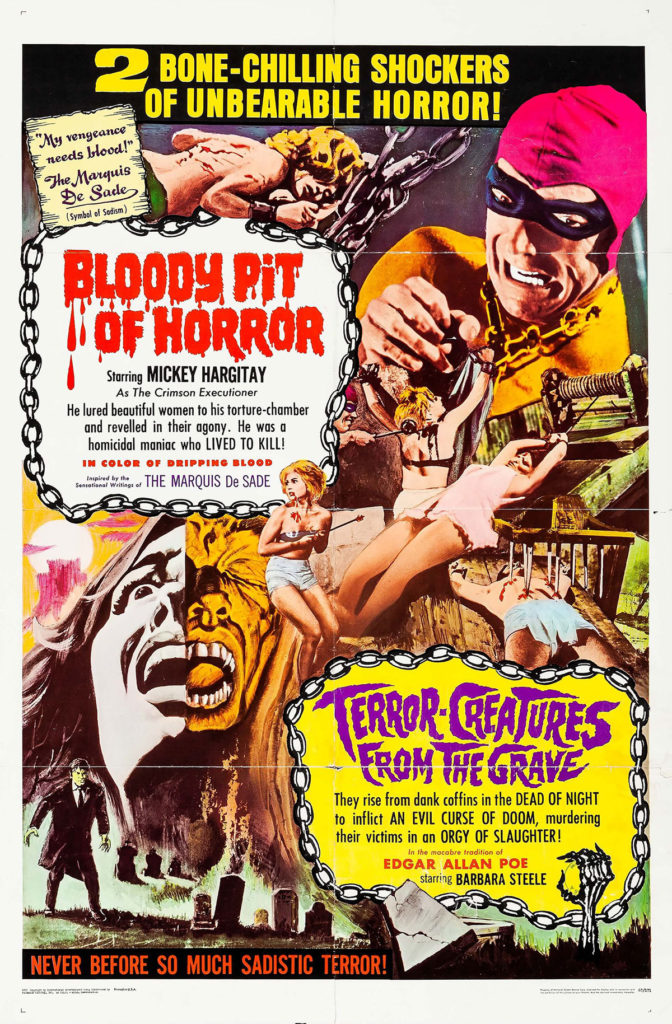 Pacemaker Pictures, the English-language distributors of Terror-Creatures from the Grave, the 1965 Italian gothic horror flick, sure went all in on the title. Perhaps they had a shortlist and couldn’t decide between Terror from the Grave and Creatures from the Grave so, like some parents, decided to burden their charge with a hyphenated name. It’s a mouthful, but has loads of kitsch to it.
Directed by Massimo Pupillo, from a screenplay by Romano Migliorini and Roberto Natale, Terror-Creatures is plays like a pageant in honor of horror cinema. Shot in stark black and white by Carlo Di Palma, the film relies heavily on early horror film styles and storytelling, while combining it with contemporary trends in Italian cinema. There’s the dark and stormy night, overlayered with endless theremin music, combined with dramatic closeups and the multinational cast mouthing their lines in different languages. It’s like watching an old Universal horror film, and everyone is poorly dubbed. Unfortunately, that dubbing can be somewhat distracting, but Pupillo and company nevertheless made a decent horror film. Continue reading “Terror-Creatures from the Grave, aka 5 tombe per un medium”
Guru, the Mad Monk
 There are giants in the history of shitty cinema. Roger Corman, Bert I. Gordon, Herschell Gordon Lewis, Lloyd Kaufman, Ray Dennis Steckler, amongst many others. Then there are filmmakers like Andy Milligan. Milligan was a worker, with dozens of films in his oeuvre. But he sure did make some trash. Most shitty filmmakers would make something like Guru, the Mad Monk, and then have to call it quits. Having a film this bad in one’s CV is kryptonite to investors, but Milligan managed to make shitty films for another two decades after Guru’s release. That’s dedication.
Released in 1970, Guru, the Mad Monk has very little to recommend it, to even the most diehard of shitty movie fans. Mercifully short at just 56 minutes, Milligan, who wrote as well as directed, displayed a profound lack of skill as a storyteller and filmmaker.
He sets the bar low early on. Filmed entirely in a Manhattan church, Milligan made just about no effort to conceal the fact his location was in a bustling city, and not on some fictional, medieval island in Eastern Europe, where the story takes place. Continue reading “Guru, the Mad Monk”
The Devil’s Hand
Rick Turner (Robert Alda), is, by all appearances, in a happy relationship with Donna Trent (Ariadne Welter). The two of them are clean-cut, 1950s wholesome, and engaged to be married. But, a mysterious, beautiful woman has been appearing to Rick in his dreams. One day, as he and Donna are walking about, Rick sees a doll in the display window of a dollmaker’s shop that has an uncanny resemblance to the woman in his dreams. He goes inside, and sets in motion a tale of evil and death.
Such is the setup to The Devil’s Hand, a kitschy 1961 horror flick from writer Jo Heims and director William J. Hole, Jr. By kitschy, I mean that this film has the look and feel of Ed Wood. I don’t mean a film directed by Ed Wood. I mean the Tim Burton biopic. I have no idea what exact sources Burton found for inspiration. Perhaps this flick was on the list. Continue reading “The Devil’s Hand”
Blood Sabbath, or, My Soul for Some Strange
 What a bucket of sleaze. Blood Sabbath, the 1972 exploitation horror flick from screenwriter William A. Bairn and director Brianne Murphy, is exactly the kind of movie that gets the pious all worked up. Gratuitous nudity only begins to describe the amount of flesh in this movie. This is one of those drive-in classics packed full, from start to finish, with butts, boobs, and bush. Add in witchcraft, and one would be hard-pressed to find an R-rated film more capable of moral corruption. It’s spectacular.
The film follows Vietnam War vet David (Anthony Geary). He’s having a rough time with what he experienced in the war, and has gone on a walkabout that takes him, I think, into Mexico. The film isn’t clear on that. While there, he is accosted in the night by three naked partiers and chased through the woods. He trips and falls, hitting his head on a rock and falling unconscious. When he awakens, he finds himself being cared for by a buxom young lady named Yyala (Susan Damante). She’s a water spirit, or something similar, and the two fall in love with each other. But, David can’t get past first base because, according to Yyala, she has no soul, and it’s forbidden for her to be with someone who still has theirs. So, David makes it his mission to rid himself of his soul so he can get laid. Continue reading “Blood Sabbath, or, My Soul for Some Strange”
Horror Rises from the Tomb
Writer/actor/director Paul Naschy was cinematic royalty in his native Spain. But, despite having seen piles and piles of horror flicks and shitty movies combined, this reviewer had never heard of him until doing the research for this post. My favorite factoid about Naschy is that he starred in twelve low-budget werewolf flicks, all as a character named Waldemar Daninsky, and yet each is a standalone film, featuring a new origin for Waldemar’s werewolf curse. That’s fantastic. Who retcons the same character eleven times? Naschy and his cohort over in Franco’s Spain, that’s who. I cannot wait to see them all and share my thoughts on them with you, loyal reader. Continue reading “Horror Rises from the Tomb”