
I couldn’t wait for after the Horrorshow to post this review. This flick is just too special. And what a gloriously stupid movie it is. But, a big, bombastic disaster flick is good to see every now and again. They come in waves, too. Some studio will put out a big budget disaster flick that makes a pile of cash and then all the others can’t wait to put their own into production. Then after a year or two the quality takes a dip and audiences get tired and disaster flicks go into hibernation until audiences are ready again. Marvel and DC would do well to take note. They’re reaping the benefits of their respective formulae now, but eventually audiences will rebel and one of those two will lay a big fat turd at the box office — something kin to The Core — and ruin the party for everyone (an argument could be made that this happened with the Fantastic Four reboot this summer, but for now audiences are not blaming Marvel for franchisee Sony messing up Marvel’s intellectual properties). But, I digress. Continue reading “San Andreas, or, an October Horrorshow Interlude”
Tag: Thriller Flick
Saw III
Here I go again. The absolute worst thing about torture porn is that it’s like driving by a car wreck. I cannot turn away. But, I think that may have something to do with the first two Saw films. They were tamer in comparison to Saw III. The level of physical injuries inflicted on characters in the first two films was gruesome, but this third entry in the series was where my gore threshold was finally crossed. I think it was the moment when a member of the cast almost drowns in shredded putrefied pig that did it for me. This came after seeing a man pull steel hoops from his flesh and a woman have her ribcage ripped from her body. I applaud the effects folks who came up with this stuff. They did a professional job. I just think they did it too well. Continue reading “Saw III”
Saw II
Like the poor characters who populate the Saw franchise, I seem to be a glutton for punishment. I roundly excoriated the first Saw film and the torture porn subgenre of horror in yesterday’s review, yet here I am, writing a review of another Saw flick. I can’t seem to look away, and that’s part of the point of these films, right? During the progression of the series, plot continued to descend further into a convoluted pastiche that existed only to place characters into harm’s way, where they were confronted with machinery designed to maim them and delight us viewers. Continue reading “Saw II”
Saw
I’ve mostly steered clear of torture porn when it comes to watching horror flicks. Grievous physical injury has always been a part of the horror genre, but it’s only in the last couple of decades that depictions have crept closer and closer to reality. Every person out there has a threshold for how much violence they can stomach before a film is no longer enjoyable. Torture porn usually crosses mine. While most of the films in the Saw franchise not only cross that line for me, but go sprinting past it, the first film has far less violence than its reputation would lead one to believe. To be sure, having less violence than its successors leaves it room for still quite a bit, but when it comes to the Saw franchise, less is more. Continue reading “Saw”
Extraterrestrial
A few years ago, I was pleasantly surprised by Grave Encounters, the first feature from the writing/directing team of The Vicious Brothers (Colin Minahan and Stuart Ortiz). They were working with a miniscule budget and an overdone idea, but managed to make a very good little ghost flick. Last year saw them release another film that couldn’t make it past the festival circuit, but, thanks to the internet, is reaching viewers in ways that were impossible even ten years ago. Continue reading “Extraterrestrial”
The War of the Worlds (1953)
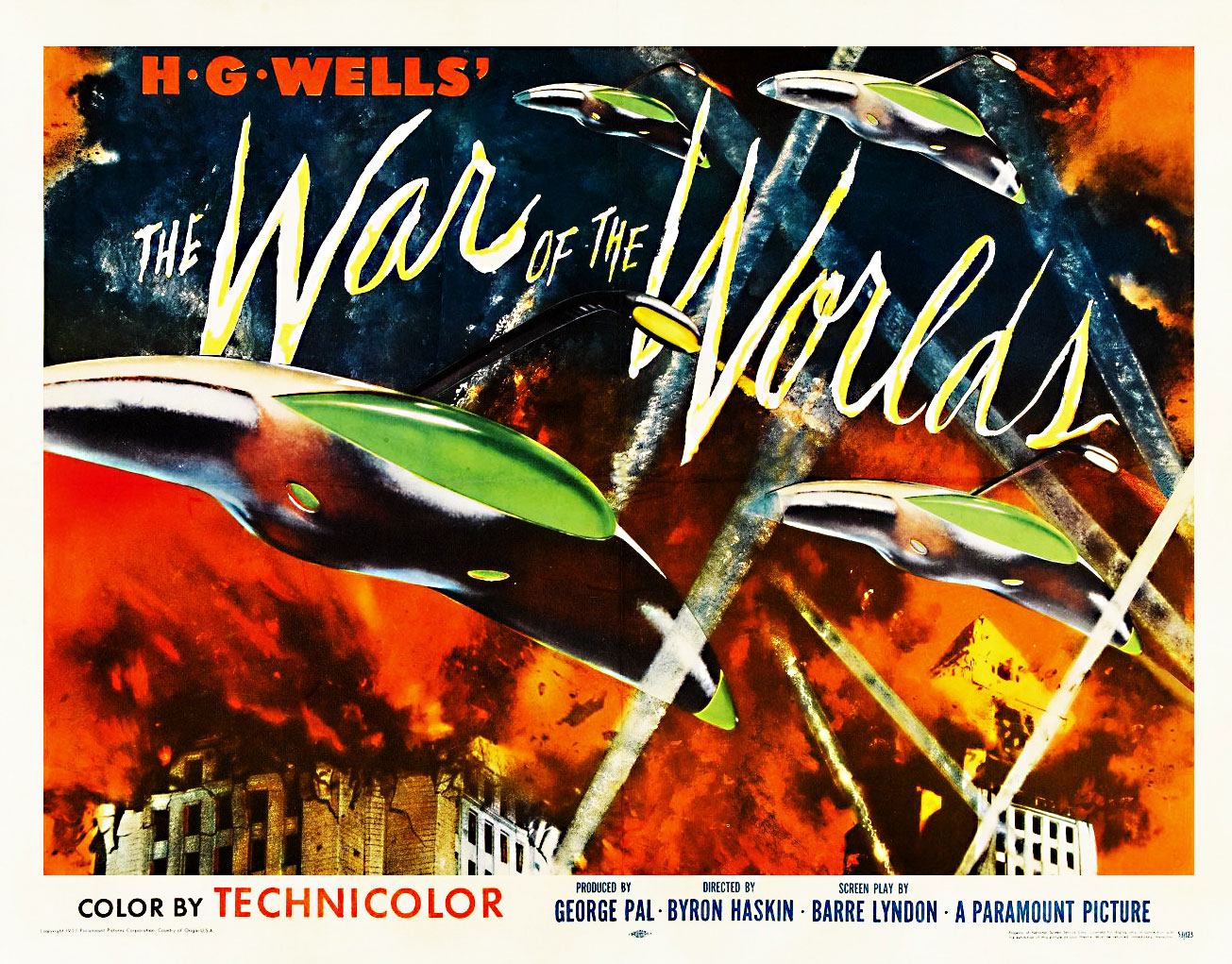 Monsters, devil worshippers, demons, ghosts, sadomasochistic inter-dimensional travelers...it can get to be too much. It’s time for the Horrorshow to take a step back from all the gore and scary stuff and spend some time with some nice, wholesome alien invaders.
From 1953 and adapted from the famous HG Wells story, The War of the Worlds is not the first alien invasion flick, but it is prototypical. A mass surprise invasion by alien beings in possession of unstoppable destructive power threatens to overwhelm the world. The situation is dire, the entire world mere days or hours from being conquered. But, against the odds, and due to providence, luck, good old-fashioned American ingenuity, or a thorough lack of understanding of the laws of nature on the part of the aliens and the screenwriters, the invaders are vanquished. And I mean vanquished. No alien invaders ever just get beat, or end up slogging into insurgency warfare (with the notable exceptions of V and Falling Skies, but that’s on TV). Aliens in these flicks get wiped out, in total, usually in a matter of minutes. The denouement in these films, The War of the Worlds included, can feel a bit rushed. But that doesn’t mean it doesn’t work. Continue reading “The War of the Worlds (1953)”
Ragnarok
Ragnarok, the 2013 film from Norway, is not a horror movie. At first glance, it has all the makings. There’s a small cast, a remote locale, an abandoned Soviet military bunker, and there’s a monster. So this is a monster movie, then? Well, yes, but not so much. As it turns out, Ragnarok is a family adventure movie. What has the October Horrorshow come to? Have I exhausted my options to such an extent that I have to dip into other genres just to fill out a month? No, I do not. But I feel I have been deceived, and have to share. Continue reading “Ragnarok”
The Substitute
What a gloriously stupid movie. From director Robert Mandel, The Substitute tells the story of Jonathan Shale (Tom Berenger), a black ops soldier who leads a team sent abroad to fight the scourge of illegal drugs. But, we viewers never get to see one of these missions. As the film starts, we meet Berenger and his team at the back end of an incursion into Cuba that has left three team members dead. The government disavows any knowledge of the operation or its participants, and throws Shale and company out on their asses. Continue reading “The Substitute”
Nightcrawler
Every serious actor has to do a film where they play a deranged freak — someone sociopathic or supremely bent who decides to interact with the people around them, much to those people’s distress. Robert De Niro in Taxi Driver, Christian Bale in American Psycho, Joaquin Phoenix in The Master, Ben Kingsley in Sexy Beast, and many others, all played men who were malignancies to every person they met. Jake Gyllenhaal has come close before, but with Nightcrawler, last year’s film from writer/director Dan Gilroy, he has gone full creepy. Continue reading “Nightcrawler”
The Equalizer
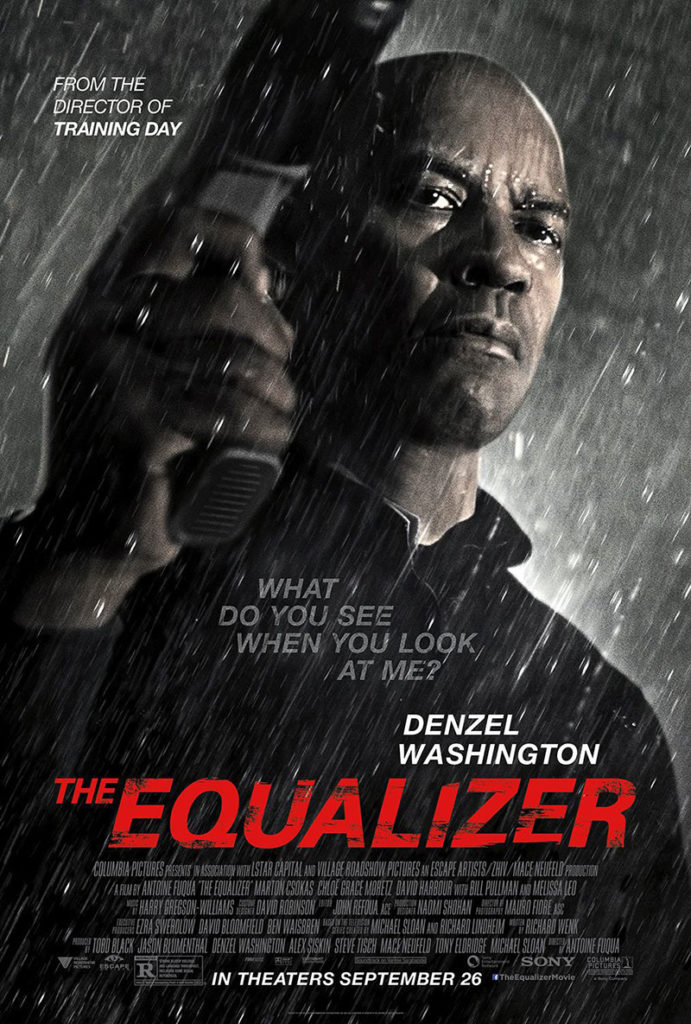 Once upon a time there was television show called The Equalizer that ran on CBS. It was successful enough to last for four seasons and 88 episodes. I don’t know if that’s significant. Any show that runs on American network television for four years and 88 episodes is a success, but it’s not a smash. In fact, The Equalizer was and is somewhat of an anonymous show. It’s curious that in the age of remakes and reboots, someone in Hollywood chose to resurrect this show and make it a movie.
From last year, The Equalizer is an action film that tells the story of one man who systematically eliminates the entire Russian mafia operating in Boston. It’s an impressive display of murderous vengeance, I must say.
Denzel Washington is Robert McCall, an hourly schlub at a big box hardware store with a shady past. He lives a Spartan life in a one bedroom, and spends his sleepless nights drinking tea and reading classic literature at a local diner. There, he meets an underage hooker by the name of Alina (Chloë Grace Moretz). One night Alina runs afoul of her masters and ends up in intensive care. It was at this point that I thought I knew where the story was going. McCall had become a surrogate father to the young girl in sexual slavery. Mess with her, and one messes with McCall. She’s the classic damsel in distress. I pictured about an hour and a half of McCall chasing down some local hoods and what not. You know, movie by numbers. But I had heard good things about this movie. I had a hard time reconciling what I had heard with such a weak potential payoff. I shouldn’t have worried. Continue reading “The Equalizer”