
Silent Night, Deadly Night

People get all twisted over small stuff. We see it often. A large chunk of modern media thrives on the outrage machine. It drives engagement, sputters out after a week or so, then the talking heads find something else with which to rile up the masses. This has been going on for a long time. Even way back in 1984, before the World Wide Web kicked the machine into overdrive, we were carving out chunks of our lives to be outrageously pissed at something that didn’t matter.

Silent Night, Deadly Night, the classic slasher flick from director Charles E. Sellier Jr., caught the attention of the outrage machine. Groups picketed theaters that were showing it, and Phil Donahue dedicated an episode of his talkshow to it. Why? Because the killer in this movie dresses as Santa Claus. That was it. That was the outrage. Santa was such a sacred cow to enough people that they were offended by the very idea of a killer Santa. The behavior of a fictional character was an attack on an institution — Christmas — that they held dear. This is familiar ground today for a certain subset of cable news viewers, but what a stupid thing to get angry about. The anger got so intense that the film was pulled from distribution after only a couple of weeks, home video releases were few, and the intact film was in danger of being lost, despite cult success and a string of sequels. Anyway… Continue reading “Silent Night, Deadly Night”
Whistle

Whistle, the 2025 horror film from writer Owen Egerton and director Corin Hardy, is something of a throwback. The conceit of a cursed object whose use brings unexpected, and sometimes ironic, death was a more common theme in horror of decades past. Paired with a cast of teenagers, films like this have been a rich breeding ground of explorations into coming of age and the sudden salience of one’s mortality. There’s a reason most of these films have young protagonists. Done correctly, these flicks give the young’uns serious chills. Done even more correctly, there is plenty of bloody mayhem for the gorehounds among us. Continue reading “Whistle”

The Corpse Vanishes

Sixty-four minutes. That’s it. The Corpse Vanishes, one of five movies featuring Bela Lugosi in 1942, uses just sixty-four minutes to tell its story. That’s not unusual for the time, but there is a ruthless efficiency to this flick that many others lack. Director Wallace Fox made sure there was nary a wasted frame in this movie, even though he filmed the same opening twice.

A strange occurrence of serial criminality has descended on the city. Brides are dying at the altar, then men, posing as undertakers, take away the corpse, never to be seen again. The film opens at one of these weddings. The bride swoons, a doctor pronounces her dead, and the body is taken, Bela Lugosi’s leering face the only clue to her fate. Then, just minutes later, another wedding with the same outcome, only this one was attended by Patricia Hunter (Luana Walters), an intrepid reporter from the local paper. Continue reading “The Corpse Vanishes”

Deadly Friend

Warner Bros. did Wes Craven dirty. Deadly Friend, from 1986, was Craven’s first feature since A Nightmare on Elm Street, which made a bucketful of money for New Line Cinema. Warners didn’t have the confidence in Craven that his previous success had earned. After a first cut of this film was poorly received by a test audience, producers and studio execs ordered reshoots. Nothing new there, but as originally shot, Deadly Friend was not a horror movie. It was a sci-fi thriller. Craven was forced to change the story, add in blood and gore scenes, and turn his film into something against his and screenwriter Bruce Joel Rubin’s intent. Continue reading “Deadly Friend”

Grizzly

Jaws was released on June 20th, 1975. Less than a year later, on May 12, 1976, Grizzly, a wild ripoff, hit theaters. According to the internet, so it must be true, producers/screenwriters Harvey Flaxman and David Sheldon made no secret about the film’s origins. They were very much looking to cash in on the success of Jaws. By October of 1975 director William Girdler was filming, and by the end of the next year, Grizzly became the highest grossing independent film up to that time.

I was surprised to learn Grizzly is an independent flick, because it has the look and feel of mid-budget studio schlock, or even a TV movie from the era. I couldn’t help feeling this was exactly the kind of movie Jaws would have been had it not been in Spielberg’s hands. Even the main cast is perfect for studied mediocrity. Continue reading “Grizzly”

Timesweep

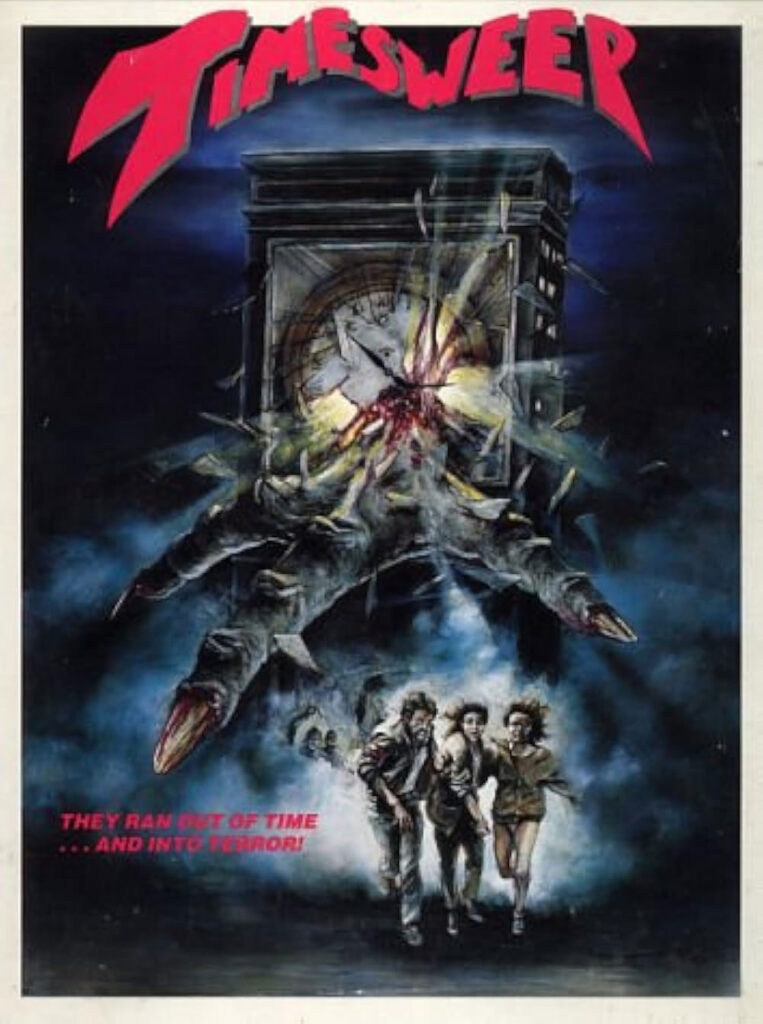
Timesweep movie posterSomeone out there, somewhere, owns the rights to Timesweep, the 1987 magnum opus from writer/director Dan Diefenderfer (screenplay credits were shared with Larry Nordsieck and John Thonen). As of this writing, Timesweep is nowhere to be found on streaming services, outside of the nooks and crannies where someone has uploaded an old VHS transfer. For shame. This movie is right up Tubi’s alley, and I’m sure whoever owns the rights could use the extra fifty bucks. Anyway…
Timesweep tells the tale of a bunch of mild-mannered 30-something Midwesterners who find themselves trapped in an abandoned building that is hopping through time. Monsters, aliens, zombies, a crazed hermit, killer bugs, and more abound, providing the audience with a surprising amount of gore for so moribund a budget.

The building in question is an old film studio that is slated for demolition. An architecture professor, Vincent Hill (Kevin Brief), a film professor, H.G. Lewis (Frank Vrooman), and students have gathered to explore the old edifice before it’s gone forever. Joining them is a local news anchor covering the story, Angela Markell (Denise Gray), and cameraman Mike Romero (Michael Cornelison). Mike is the rebel of the movie. One can tell because he shows up two minutes late, and he’s rocking a beige jacket. Yeah, there were some wild folks in Kansas City, Missouri in the 1980s. Continue reading “Timesweep”

Empire of the Dark

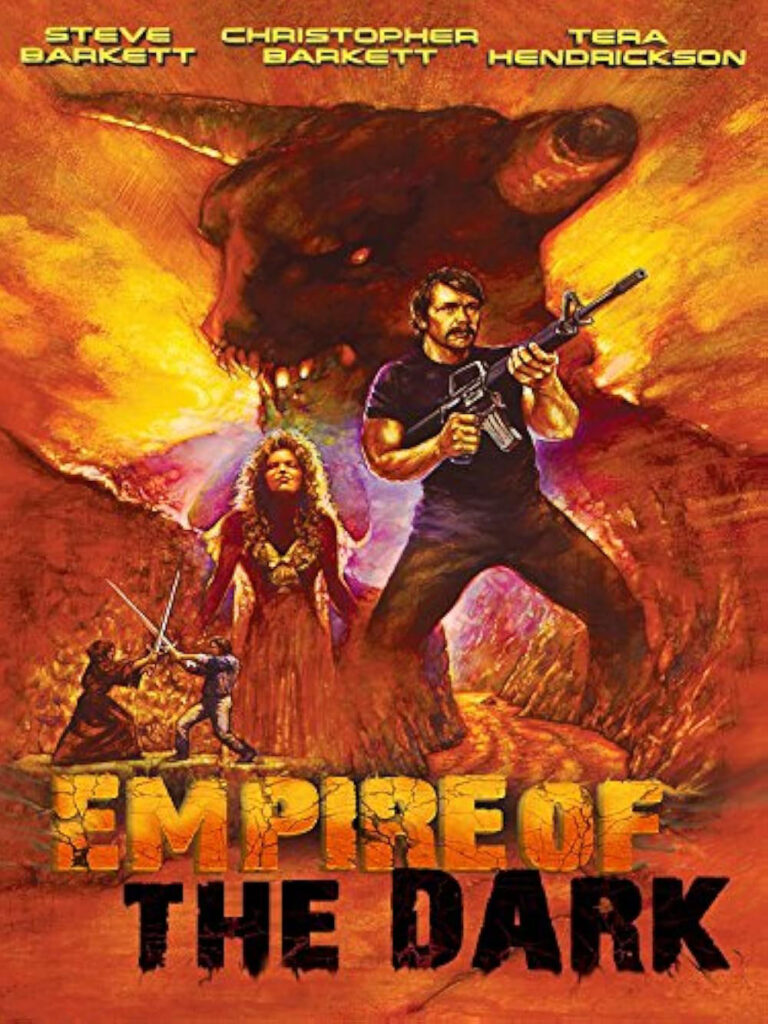
Empire of the Dark movie posterAspiring auteur Steve Barkett made but two movies during his life, which is two more than most of us. The first, The Aftermath, from way back in 1982, was a passion project that took him years to complete. His followup from 1991, Empire of the Dark, saw Barkett inject the same energy and persistence he displayed in his first movie, and the same anachronistic tendencies.
He directed, he wrote, he starred, he edited, he performed his own stunts, and he, dream of dreams, cast his own son as his co-star. A filmmaker with deficiencies in storytelling ability, acting, physicality, and much else required to make a film, Barkett’s movies are a testament to his force of will. Barkett also drew influences from 1950’s sci-fi and monster flicks, and shot his films like something from the early ’70s. Makeup and latex mask effects swing from b-movie quality to off-the-rack Halloween store fare. Mannequins take bullets to the head with red corn syrupy splatter. Creature effects are a mix of amateur puppetry and stop motion, including what looks like repurposed action figures. At some point in his life, Barkett became interested in broadsword fighting, and incorporated this new skill into his movie. Whatever doubts he may have harbored while making his film, and all artists are plagued by doubts, he cast aside and plowed through. Add Barkett to one’s mental list of perseverance personified, all you aspiring filmmakers. He made shit, but it’s fun shit. Continue reading “Empire of the Dark”

976-EVIL

The 1980s remain my favorite decade for horror flicks. In general, that decade had a much lighter take on the genre than the 1970s, despite all the splatter. In the ’70s, the aim of horror auteurs was to disturb, or to inspire dread. Take the career of Wes Craven, for example. His two most provocative films of the ’70s were The Last House on the Left and The Hills Have Eyes. Both use rape as a plot device, and both rely far more on dread than fear. Then, in the ’80s, Craven launched the Nightmare on Elm Street franchise, which embraced a fun house atmosphere, embodied in antagonist Freddy Krueger. And I do mean fun house. Freddy, with his razor glove, the facial scarring, and the exaggerated sweater and hat, is a horror movie clown. Jason Voorhees, over in the Friday the 13th franchise, is a horror movie clown. Chucky, from Child’s Play, is a horror movie clown. Et cetera, et cetera. The ’80s were awash in blood, but the tone is far different than what came before. Continue reading “976-EVIL”

Absentia

Filmmaker Mike Flanagan has made quite a career for himself in horror, having now racked up an impressive filmography as a writer, director, editor, and producer. His credits include a pair of well-received Stephen King adaptations and some excellent single-season television shows. He began, like many other artists, from humble beginnings. Flanagan’s first feature-length film was Absentia, which had a budget of around $70,000, and was partially funded through a successful Kickstarter campaign.

Absentia follows sisters Tricia and Callie (Courtney Bell and Katie Parker). Life hasn’t been easy for the two. Callie, in desperate need of stability, is a recovering drug addict who has come to stay with Tricia in Glendale, California. Meanwhile, Tricia is married, but her husband, Daniel (Morgan Peter Brown), has been missing for the past seven years, and it’s time to have him declared dead in absentia so she can collect on his life insurance policy, get the creditors off her back, and move on with her life. Oh, she’s also into her third trimester, the father being Detective Mallory (Dave Levine), who has been handling her husband’s missing persons case. That is some drama. Continue reading “Absentia”

Killer Crocodile

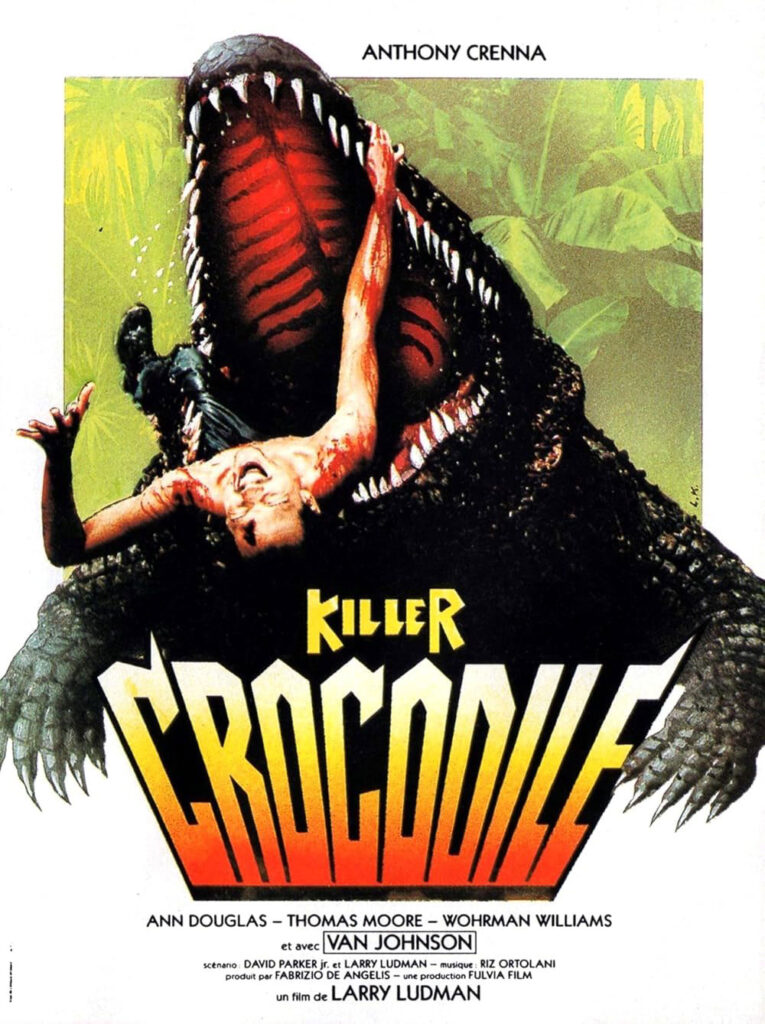
Killer Crocodile movie posterWho doesn’t like a shitty Jaws ripoff? Honestly, plenty of people. But enough do like it that giant animal flicks have become a robust subgenre of b-horror the last couple of decades, thanks to the work of outfits such as The Asylum, and the availability of affordable CGI. Jaws ripoffs aren’t the sole province of the 21st century, though. The Italians, whose cinema has always had a mere passing relationship with copyright law, produced plenty of their own…homages…to Steven Spielberg’s blockbuster.

Bruno Mattei, Dino De Laurentiis, Sergio Martino, Enzo G. Castellari, Ovidio G. Assonitis, Raffaele Donato, Lamberto Bava, Luigi Cozzi, Dardano Sacchetti, Joe D’Amato, and more — all names familiar to fans of Italian genre films, all of whom participated in Jaws ripoffs. Add to the list Fabrizio De Angelis, who produced, directed, and wrote, with the aforementioned Dardano Sacchetti, 1989’s Killer Crocodile.

Killer Crocodile follows a small group of conservationists who are investigating contamination in a rural swamp. It’s never said what country they are in, but the movie was filmed in the Dominican Republic. Continue reading “Killer Crocodile”