
I think of The Purge, the 2013 dystopian horror flick from writer/director James DeMonaco, as a “wouldn’t it be cool if…” movie. That is, its central conceit is a whimsical, almost childish idea that doesn’t stand up to much scrutiny, but still makes a cool movie. Think something along the lines of, “Wouldn’t it be cool if a class of students was shipped to an island and there was a winner take all, survival to the death challenge?” And that’s how we got Battle Royale. Or, “Wouldn’t it be cool if it turned out reality was really a simulation?” That idea gave us The Matrix. Or, one of my personal favorites, “Wouldn’t it be cool if Manhattan was a maximum security prison?” That idea got audiences Escape from New York.
For The Purge, it would be, “wouldn’t it be cool if all crime, including murder, was legal for one night a year?” Sure, for a movie, that’s a cool idea. According to the internet, so it must be true, the impetus for the idea was a road rage incident involving DeMonaco, and a heat-of-the-moment observation by his wife.
So, the conceit for The Purge is that from 7:00pm to 7:00am, one night per year, all crime is legal, with murder seeming to be the most popular option. The lore behind this is that sometime around 2014, the economy collapses so spectacularly that crime skyrockets to unprecedented levels. A new political party called the New Founding Fathers of America sweeps into power at the next election, and one of their central tenets is that 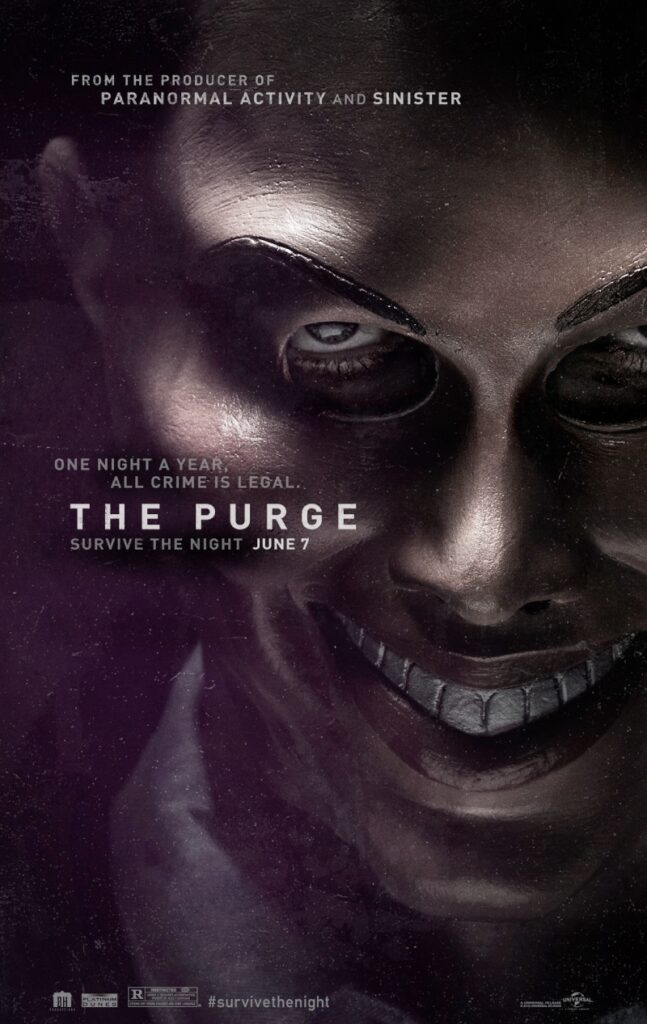 human beings are inherently violent creatures, and it is foolish to deny that reality. The purge is a yearly ritual designed to ‘release the beast’ and allow Americans to rid themselves of their bloodlust, at least until next year. In this movie’s world, it’s an effective countermeasure to societal decay. Unemployment is at 1%, and the economy is booming.
At this point, politically-minded viewers will have all sorts of questions and concerns swirling around in their heads, including what kind of commentary DeMonaco is making about American politics. Well, no story exists in a vacuum, and the New Founding Fathers are no exception. It’s never said explicitly, but it does appear that America has fallen into authoritarianism, making this a more poignant story today than when it premiered during the Obama administration. But, while the politics, and class warfare, aspects of the film can weigh heavily should one choose to let it, I say ignore all that stuff. For one thing, it’s pretty shallow. For another, this is a home invasion flick at heart, and the act of purging is just the vehicle to put characters in danger.
It’s the near future! The year 2022! Ethan Hawke stars as James Sandin, one of the new society’s winners, and a family man to boot. His wife, Mary (Lena Headey), daughter, Zoe (Adelaide Kane), and son, Charlie (Max Burkholder), live in a huge McMansion in a ritzy gated community. James made his fortune selling home security systems designed to keep occupants safe from the purge. As the yearly ritual begins, the Sandins are safe behind steel barriers. That is, until Charlie gets a case of the guilts and lets in a wounded homeless man (Edwin Hodges) who is trying to flee his would-be killers. Because compounding crises raise tensions in movies like this, Zoe’s boyfriend (Tony Oller) snuck into the house with some poorly thought out ways to keep James from interfering in his relationship.
This is just the start of the chaos, as not long after, a group of spoiled private school rich kids, out purging, show up on the Sandin’s doorstep demanding the homeless man be sent out, so they can finish him off. They are led by a character billed as Polite Leader, played by Rhys Wakefield. In a movie led by a studied professional in Ethan Hawke, it is Wakefield who steals the show. He plays the stereotypical, sociopathic aristocratic youth with aplomb. That is, he’s so punchable that viewers will be able to taste it.
For a good amount of the film, it’s a cat and mouse game in the cavernous house as James and family try to track down the homeless man. Then, their patience exhausted, the brats smash their way into the house, and the film morphs into a frenetic, violent action extravaganza. There are bodies and blood all over the place, then one final twist before the sun rises, ending that year’s purge.
Without the end credits, The Purge clocks in at a svelte 79 minutes. Almost by default, then, this flick was going to have a good pace. DeMonaco was smart with the lore, too. Much of the necessary exposition is gotten out of the way during an opening credits montage, and none of the characters dwell on the absurdity of it all. Pangs of conscience do enter into the plot, but not enough to interfere with the main action. Anything that was a hindrance to this movie’s forward motion seems to have been left on the cutting room floor. The result is a tight film that, almost, doesn’t require the idea of a purge at all. Plenty of home invasion flicks have been made with far less lore. This take on home invasion is exciting, disturbing, and much better than the idea that spawned it.