
Evil Dead (2013)

Is Evil Dead, the 2013 film from Fede Alvarez, a remake or a sequel? It looks a lot like a remake, but, years after release, Alvarez confirmed in a tweet that, “[Evil Dead] continues the first one.” Case closed. This flick is not a remake. I guess the original was just so good they had to make it twice, or thrice, for that matter.

Working from a screenplay he wrote with Rodo Sayagues, Alvarez made a horror flick that reportedly used tens of thousands of gallons of fake blood. If that’s not an intrinsic endorsement, I don’t know what is.

The movie follows five twenty-somethings who think they’re doing the right thing, but pick the worst place in the world for it. Continue reading “Evil Dead (2013)”

House (1977)

The Japanese are the undisputed kings of weird. I’ve seen thousands of movies from scores of countries, and it is Japanese flicks that are the most consistently bizarre. The Japanese have a reputation as being a staid and conservative people, but when it comes to their art, they have outlets for their inner weird, and they take advantage of it.

From way back in 1977 comes House, a movie that does its best to defy description, but I’m going to give it a try. Picture a stage set fever dream with painted backdrops, bright colors, the aesthetic sensibility of a TV show made for toddlers, scenes reminiscent of NES-era Final Fantasy cutscenes, with music that sounds made for both hippies and long elevator rides. If that picture doesn’t resolve clearly in one’s head, that’s okay, no description of this film will. Take these lines from my notes: Continue reading “House (1977)”

Do Not Enter

I’m a sucker for urban exploration. And I’m a sucker for horror flicks. Put the two together and I will watch it. Mostly, these kinds of movies have been disappointing, but that could be said for any subgenre of film. For every good movie, there are three dogs.

Today’s dog is Do Not Enter, based on the novel Creepers by David Morrell. It was helmed by prolific music video director Marc Klasfeld, from a screenplay by Dikega Hadnot, Spencer Mandel, and Stephen Susco. The story is simple, which is a plus for a movie like this.

The Paragon, a luxury hotel on the Jersey Shore, has been abandoned for decades. Rumors are that Meyer Lansky, the infamous gangster, had a secret stash of millions of dollars in the hotel, and it is still there waiting for someone to find it. This catches the attention of The Creepers, a group of urbexers trying, and failing, to get internet famous. But, The Paragon has been a well-known and unattainable get amongst the urban exploration community, so they think doing a proper exploration, and finding the money, to boot, would get them the views they crave. Continue reading “Do Not Enter”

Obsession

Boy, did this movie make a splash at the box office. One of three movies in wide release this past year that upended industry conventions about horror (the others being Backrooms and Iron Lung), Obsession pulled in over 500 million bucks against a budget of around three-quarters of a million. Those kinds of numbers make the suits take notice. It’s not the first time something like this has happened. In the late 1990s it was The Blair Witch Project that thumbed its nose at Hollywood, and in the next decade Paranormal Activity did it again. Every so often the industry gets a reminder that bigger isn’t better, and that they don’t have sole license on what people are allowed to like. What’s unique is that three movies did this in the same year. But, Missile Test doesn’t give a damn about numbers and return on investment. What we appreciate is that an independent filmmaker was able to make their movie, and get it seen. Continue reading “Obsession”

The Demon’s Rook

Had The Demon’s Rook been made in the 1980s or 1990s, it would have been shot on videotape. This is very much kin to the kinds of movies the Polonia brothers or Andreas Schnaas were making back then. All the bona fides are there. It was the passion project of an aspiring filmmaker and an amateur cast and crew. It’s very bloody and gory, yet the effects are inexpensive. And it took a long time to shoot, with this particular flick eating up weekends for two years, if the internet is to be believed.

Released in 2013, the driving force of The Demon’s Rook is filmmaker James Sizemore, who wrote (with Akom Tidwell), produced (with Tim Reis), directed, and starred. Reis contributed further as editor and cinematographer.  The Demon’s Rook tells the story of Roscoe (Sizemore), who, when he was a young boy (played by Emmett Eckert), was recruited by a demon, Dimwos (John Chatham), to become an apprentice in demonic magic. The price is high, as Roscoe not only has to abandon his life, but his parents become blood sacrifices, and Roscoe is held prisoner well into his adulthood in a separate dimension. Continue reading “The Demon’s Rook”

Fatal Images

Fatal Images VHS boxIn the decades since the 1989 release of Fatal Images, filmmaker Dennis Devine has staked out quite a place in low budget, trash horror cinema. Of the thirty-four directorial credits on his IMDb page that have viewer ratings, the average score is 3.8 out of 10. That’s pretty bad. Any single movie that garners a score that low is probably not worth the effort to watch, and that number covers Devine’s entire career. Some would say he should have thrown in the towel a long time ago, but shit on that. Devine is a filmmaker. It doesn’t matter that he makes crap. He makes movies, and no matter how bad they are, there is an audience of mutants out there who reject force fed studio movies — who experience culture outside the big corporate stranglehold on media. Sure, his movies stink. But every blown line, every plot hole, every frame of bland, desaturated magnetic video is a ‘fuck you’ to the moneyed gatekeepers of cinema.

Fatal Images, also written by Devine, with Mike Bowler and Steve Jarvis, is a supernatural slasher flick. Shot on glorious videotape, the film tells the story of deceased serial killer Kurt Cosgrave (David Williams); the camera that holds his murderous spirit (played by a Panon Widelux); and the photographer who buys the camera at a pawnshop, Amy Stewart (Lane Coyle). Continue reading “Fatal Images”

A Chinese Ghost Story

A Chinese Ghost Story movie posterA Chinese Ghost Story, from Hong Kong actor, stuntman, and filmmaker Siu-Ting Ching (screenplay by Songling Pu and Kai-Chi Yuen), is, according to the internet, a xianxia film. Xianxia are ‘closely related to the wuxia and shenmo genres.’ There is some cultural illiteracy here, on my part, but those strange new terms basically mean ‘based within Chinese mythology.’ Now we’re getting somewhere. If one has seen a Hong Kong martial arts flick that takes place before the emergence of modern China, one will be familiar with the look and feel of A Chinese Ghost Story. It’s a piece of fantasy, encompassing demons and the supernatural, with Hong Kong martial arts movie trickery thrown in, and comedy to keep things light.
The movie follows Leslie Cheung as Ling Choi San, a debt collector suffering from multiple slapstick maladies, who makes the mistake of spending a night in a haunted temple. There, he meets Yin Chek Ha (Wu Ma), a swordsman who retired from the civil service in disgust at the corruption, and now spends his time ridding the country of evil spirits. Yin Chek Ha is at the temple because it has recently been taken over by an evil tree demon (Siu-Ming Lau). All the inhabitants and caretakers have been killed and turned into stop motion zombies by the tree demon. It has also seized some recently deceased souls, which it uses to capture more innocent people to feed its insatiable appetite. Continue reading “A Chinese Ghost Story”

Whistle

Whistle, the 2025 horror film from writer Owen Egerton and director Corin Hardy, is something of a throwback. The conceit of a cursed object whose use brings unexpected, and sometimes ironic, death was a more common theme in horror of decades past. Paired with a cast of teenagers, films like this have been a rich breeding ground of explorations into coming of age and the sudden salience of one’s mortality. There’s a reason most of these films have young protagonists. Done correctly, these flicks give the young’uns serious chills. Done even more correctly, there is plenty of bloody mayhem for the gorehounds among us. Continue reading “Whistle”

Timesweep

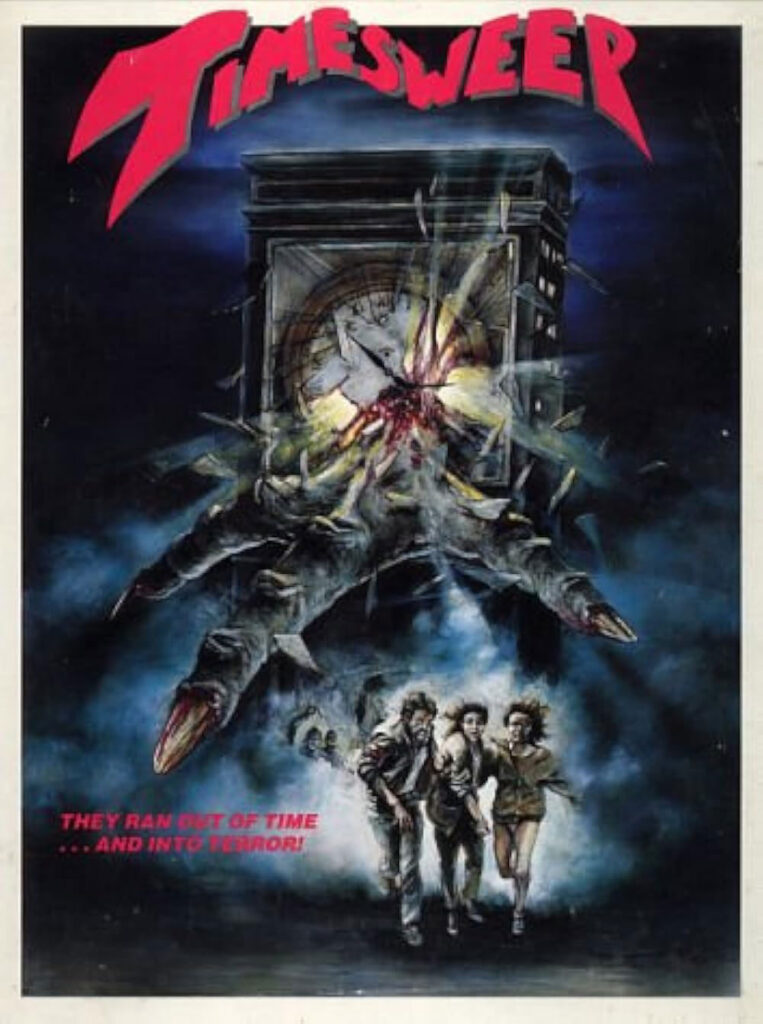
Timesweep movie posterSomeone out there, somewhere, owns the rights to Timesweep, the 1987 magnum opus from writer/director Dan Diefenderfer (screenplay credits were shared with Larry Nordsieck and John Thonen). As of this writing, Timesweep is nowhere to be found on streaming services, outside of the nooks and crannies where someone has uploaded an old VHS transfer. For shame. This movie is right up Tubi’s alley, and I’m sure whoever owns the rights could use the extra fifty bucks. Anyway…

Timesweep tells the tale of a bunch of mild-mannered 30-something Midwesterners who find themselves trapped in an abandoned building that is hopping through time. Monsters, aliens, zombies, a crazed hermit, killer bugs, and more abound, providing the audience with a surprising amount of gore for so moribund a budget.

The building in question is an old film studio that is slated for demolition. An architecture professor, Vincent Hill (Kevin Brief), a film professor, H.G. Lewis (Frank Vrooman), and students have gathered to explore the old edifice before it’s gone forever. Joining them is a local news anchor covering the story, Angela Markell (Denise Gray), and cameraman Mike Romero (Michael Cornelison). Mike is the rebel of the movie. One can tell because he shows up two minutes late, and he’s rocking a beige jacket. Yeah, there were some wild folks in Kansas City, Missouri in the 1980s. Continue reading “Timesweep”

976-EVIL

The 1980s remain my favorite decade for horror flicks. In general, that decade had a much lighter take on the genre than the 1970s, despite all the splatter. In the ’70s, the aim of horror auteurs was to disturb, or to inspire dread. Take the career of Wes Craven, for example. His two most provocative films of the ’70s were The Last House on the Left and The Hills Have Eyes. Both use rape as a plot device, and both rely far more on dread than fear. Then, in the ’80s, Craven launched the Nightmare on Elm Street franchise, which embraced a fun house atmosphere, embodied in antagonist Freddy Krueger. And I do mean fun house. Freddy, with his razor glove, the facial scarring, and the exaggerated sweater and hat, is a horror movie clown. Jason Voorhees, over in the Friday the 13th franchise, is a horror movie clown. Chucky, from Child’s Play, is a horror movie clown. Et cetera, et cetera. The ’80s were awash in blood, but the tone is far different than what came before. Continue reading “976-EVIL”