
Saban Films is a clearing house for crap. I have yet to see anything bearing the Haim Saban imprimatur that wasn’t total garbage. From distributing low-rent Japanese television imports Dragon Quest and Power Rangers decades ago, to spreading Dolph Lundgren films the world over, Saban continues its quest to bore viewers to death. Such is the case with Armed Response, whose production companies include WWE Studios. Sometimes, viewers can know what they’re in for before all the pretentious opening logos have flashed past. Continue reading “Armed Response (2017)”
A Handful of Gravy

Stanley
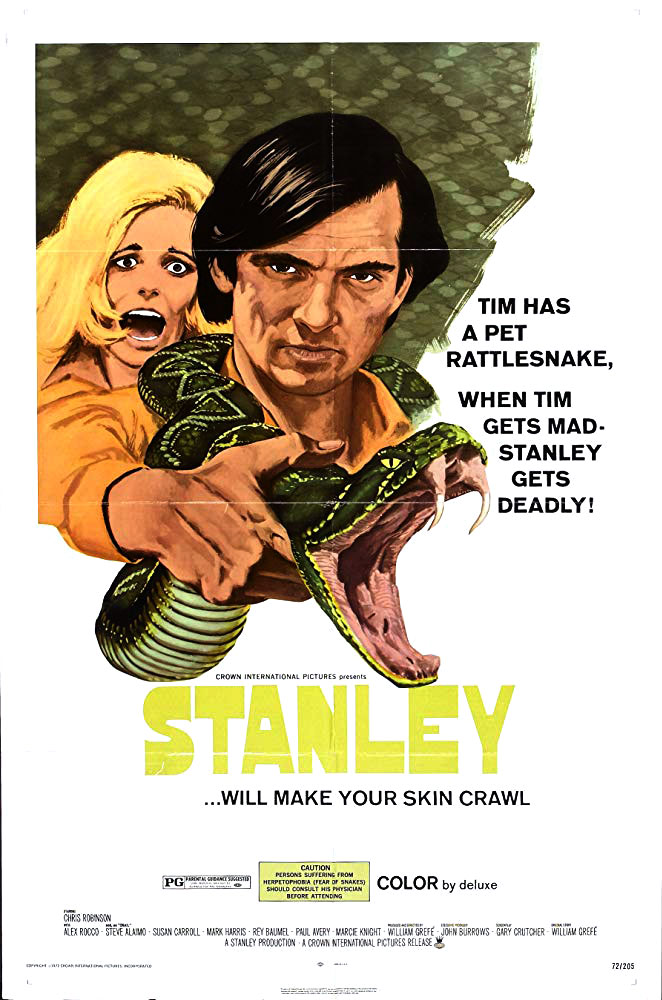 I love it when a film’s main character is an eccentric nutjob. I don’t mean a character remembered for an over the top performance by an actor, like a Captain Jack Sparrow or even the Joker. I’m referring to characters who have quirks so wild they defy typical Hollywood tropes. Take the main character in 1972’s Stanley, Tim Ochopee (veteran soap opera actor Chris Robinson).
Tim is a Seminole who was drafted to go off and fight in Vietnam. He harbors massive amounts of resentment, all justified, towards the government of the white man. His response to this, and PTSD, has been to pull back from society, moving to a lonely cabin in the Everglades. But, isolation was not enough for Tim. He has a fascination with snakes. He loves them and considers himself their protector. His two favorites are the titular Stanley and Hazel, a pair of rattlesnakes that he is breeding. He croons to them. He pets them lovingly. He takes Stanley with him everywhere, and gives Stanley orders like he’s a dog and not a reptile. He thinks of Stanley and Hazel as husband and wife. All meaning Tim gets from his life, he derives from his snakes. And, he will kill for them. Continue reading “Stanley”
Blood Mania
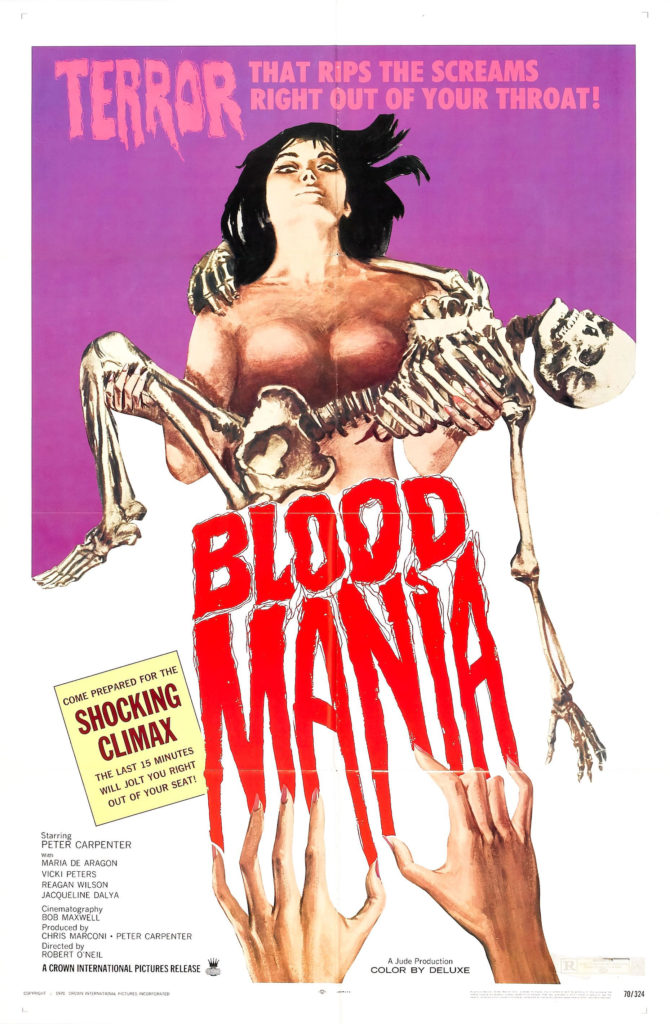 There is some sleaze to Blood Mania, the 1970 neo-noir drive-in flick from purveyors of shit Crown International Pictures. Tony Crechales and Toby Sacher were responsible for the screenplay, while Robert Vincent O’Neil sat in the director’s chair.
The plot is straight out of an old issue of Crime SuspenStories. A wealthy, aging doctor, Ridgeley Waterman, played by Eric Allison, is on his deathbed. He is being cared for by one of the partners in his practice, Dr. Cooper (Peter Carpenter, who is also credited with this film’s story). Cooper is being blackmailed by some smarmy gangster played by Arell Blanton. The blackmailer has concrete evidence that Cooper performed abortions while he was in medical school. This film being from 1970, abortions were a crime, and Cooper’s life and career would be ruined if the authorities were to find out. All it will cost Cooper to make this threat go away is fifty thousand dollars, which is much more than Cooper can raise.
Perhaps he could go to his boss for help, but he doesn’t. Instead, he gives in to the advances of one of Ridgeley’s daughters, Victoria (Maria De Aragon). Continue reading “Blood Mania”
The Amazing Transparent Man
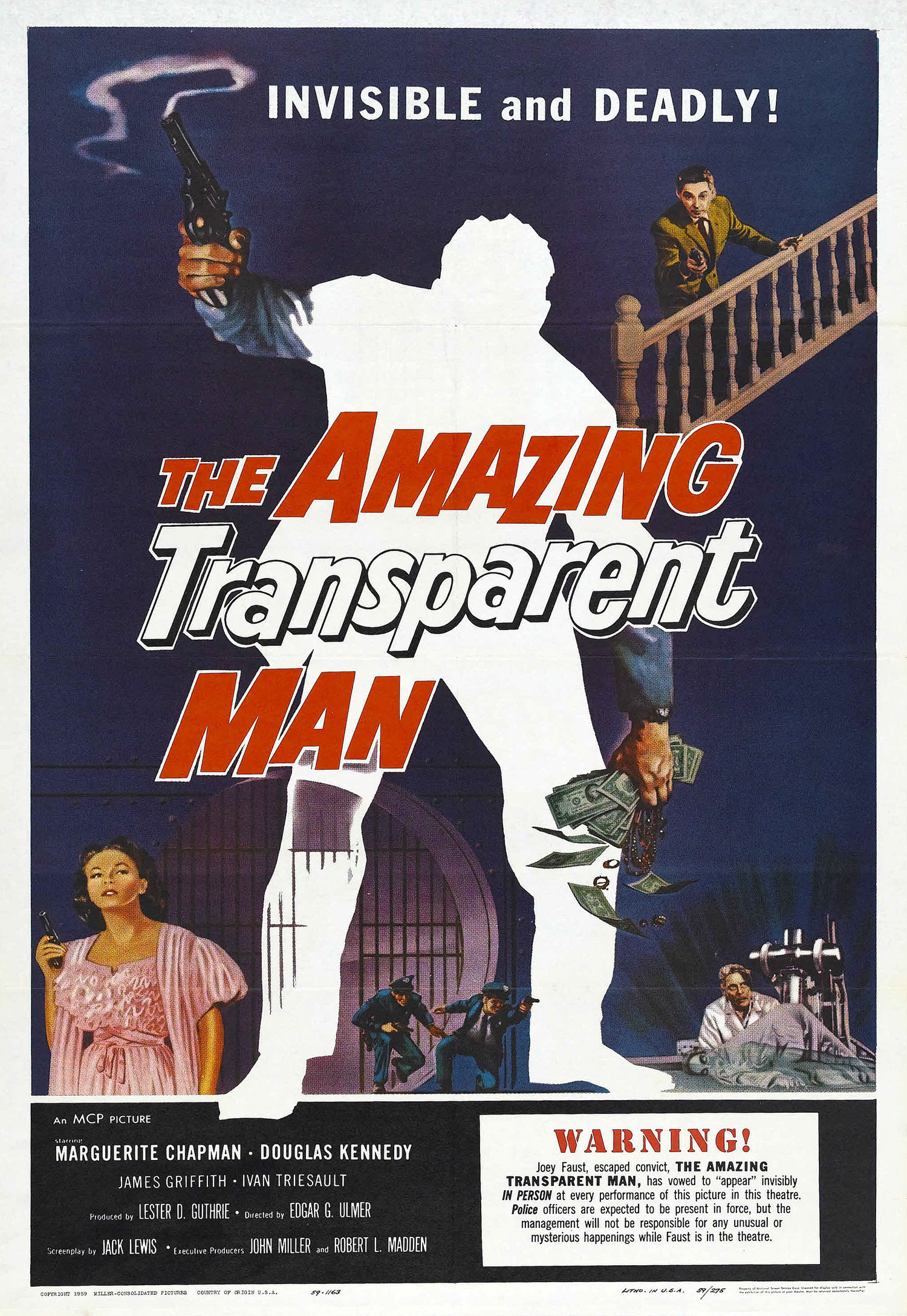 58 minutes! Are you kidding me? We here at Missile Test enjoy filmmakers who show brevity in their storytelling, but a 58-minute running time is a little bit extreme. Perhaps director Edgar G. Ulmer should be praised. After all, most shitty movie directors of the era would have just thrown in stock footage or long establishing shots to pad the running time. But not Ulmer. His film is so Spartan that viewers will even notice some scenes with dialogue were trimmed. I applaud Mr. Ulmer for trying not to waste anyone’s time, but still…58 minutes!
Released in 1960, The Amazing Transparent Man is a bizarre combination of film noir and science fiction. The film follows Joey Faust (Douglas Kennedy), a career bank robber who is serving a long stretch in a penitentiary. As the film opens, we see Faust escape from prison, aided in his escape by Laura Matson (Marguerite Chapman). Faust doesn’t know why the escape was arranged, only that he’s being taken to a home in the countryside. Continue reading “The Amazing Transparent Man”
I’ve Never Liked Robin

The Thirsty Dead
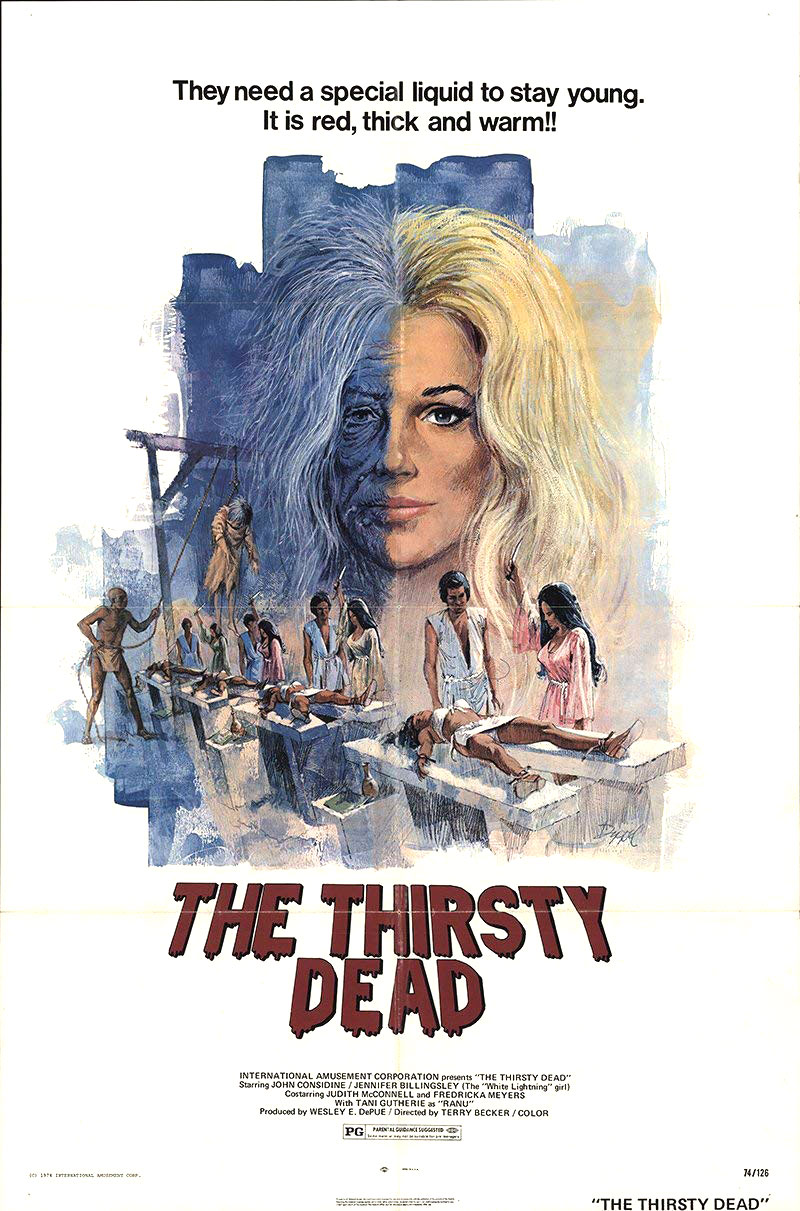 What The Thirsty Dead is not: a film about zombies, or vampires, or other undead creatures preying on the innocent and spilling buckets of fake blood. There is no gore, and no more than a few dollops of blood. Despite this being from 1974, the wheelhouse for drive-in movie exploitation, there is no nudity, gratuitous or otherwise, despite four main cast members being young(-ish), buxom(-ish) ladies.
What The Thirsty Dead is: a film with a misleading title. That happens often with shitty movies. It’s a crime compounded by the fact that not only is this movie not about thirsty dead things, it’s not even a horror flick. There are horror elements to the plot, but there just isn’t enough for this film to cross over into that hallowed genre. This is just exploitation schlock, done poorly. Exploitation films are supposed to be downright sleazy — a guilty pleasure that will get one strange looks from the ideological purity police. This film flirts with sleaze, but never commits. Seriously, what kind of exploitation film needs zero edits to be suitable for commercial television? Continue reading “The Thirsty Dead”
Shanghai Fortress
 How do I know China is a superpower? Besides the massive economy, the massive military, the massive population, and China’s massive effect on world politics? It’s because the Chinese are now making alien invasion movies where they save the day. That is when a nation truly arrives at the forefront — when they can make jingoistic popcorn cinema of the world-saving variety. And, like most American forays into such material, it stinks.
Shanghai Fortress is an adaptation of the sci-fi novel by Jiang Nan, wherein, in the near future, a new energy source called Xianteng has been brought back to Earth by astronauts. It’s a self-replicating energy source, and clean. A new day has dawned for humanity. Except, some aliens get wind of us having Xianteng, and a gigantic spaceship arrives, Independence Day-style, to rain hell on the earth. After five years of conflict, only one major city remains: Shanghai.
On the surface things look mostly the same. The skyline is familiar, with added CGI buildings and doodads here and there. But underneath the great city, the United Nations Defense Council (the Chinese still need to work on their movie jingoism) has built a gigantic Xianteng power-generating facility, that covers the city with an energy field, and feeds a massive laser cannon. By the time the aliens get to Shanghai, they’re in for a fight. Continue reading “Shanghai Fortress”
Existential Robin

They Saved Hitler’s Brain, aka Madmen of Mandoras
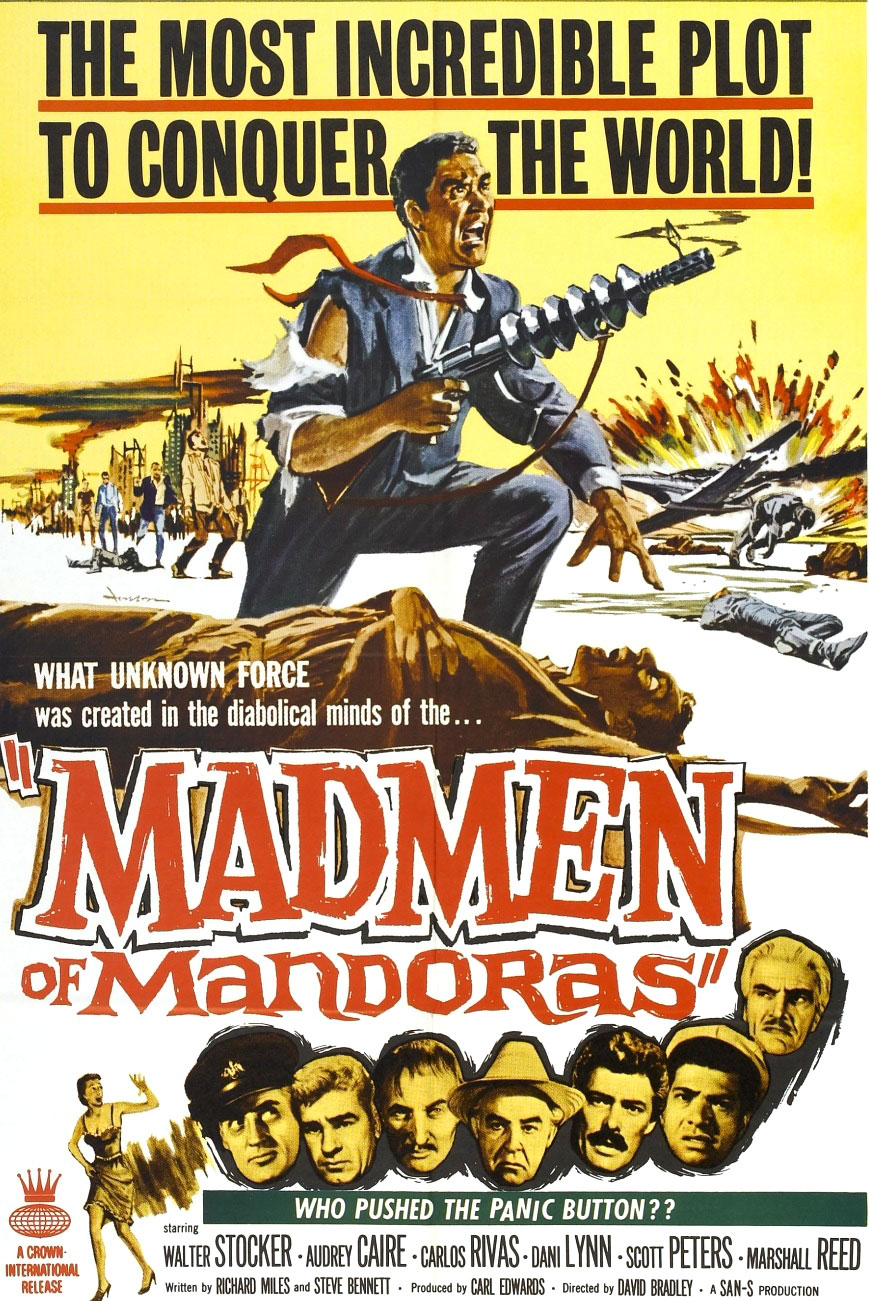 They Saved Hitler’s Brain, the 1968 sci-fi dog from director David Bradley, has one of the more unique stories in shitty movie history. It was originally released in 1963 as Madmen of Mandoras. A few years later, the owners of the film wanted to sell it for television distribution, but the original running time of 74 minutes was too short. Their solution? Hire some UCLA film students to shoot a new first act, featuring none of the cast from the original, with only a tangential connection to the main plot. These new scenes are an anachronism, looking completely out of place, because they are. The two main characters in these scenes, one of which isn’t even listed in the cast, are both killed off before the movie switches to its original content. These new scenes are a disaster in every way, from plot, dialogue, to acting. Just this part of the film is enough to make this among the worst films I’ve ever seen, and there’s still a whole hour of movie to get through. Continue reading “They Saved Hitler’s Brain, aka Madmen of Mandoras”