
I’ve seen Resident Evil four times. Each time, it gets worse. Don’t ask me why I’ve dedicated five precious hours of my life to this dog. I have no answer. I wish I could swear this last viewing was the final viewing, but who knows? Maybe it will be, now I’ve bothered to write a review. Continue reading “Resident Evil”
Tag: Action Flick
Dead Heat (1988)
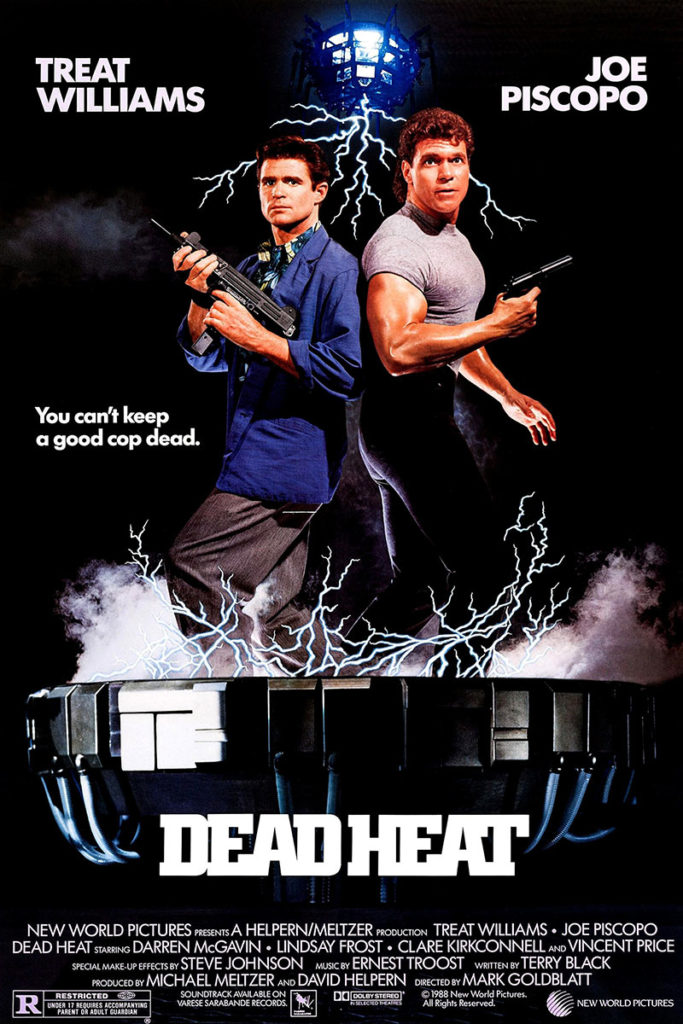 “These caps[sic] are on the biggest murder case of their lives...their own.”
So declares the DVD box art for the 1988 zombie action flick Dead Heat. When searching for a shitty movie to idly pass an evening, a typo on box art is a pretty fair indication a viewer has found a winner. Any movie called Dead Heat and starring Joe Piscopo doesn’t need any extra hint that it’s a special film, but the fact the producers didn’t care enough to release the flick with a simple bit of copy editing on the box is just icing on the cake.
Directed by Mark Goldblatt, Dead Heat follows two 1980s Hollywood-style rogue cops, Detectives Mortis and Bigelow (Treat Williams and Piscopo, respectively), as they try to track down a ring of armed robbers that have an uncanny ability to absorb massive amounts of flying bullets and not die. The film opens with a shootout of ridiculous proportions to ram this point home, as a pair of robbers armed with Uzis take on half the police force in a shootout on the street. Cops are dropping left and right, but no matter how many times the perps are shot, they just won’t go down. It takes a grenade and a speeding car to do the trick. To start the film, this scene is a total howler, in the scale of its violence and its absurdity. It does wonders to set up the rest of the film for a viewer. Continue reading “Dead Heat (1988)”
The Crazies (1973)
Is George Romero paranoid? It’s a possibility. At the very least, I would say he is mistrusting of authority. Night of the Living Dead, his seminal work, and all its follow-ups, showcase a horde of the undead rendering civilization waste. But it’s worth remembering that Romero’s zombies are not supernatural in origin. Rather, they are the result of government experiments gone wrong. Ergo, it’s not the zombies that are the greatest threat to civilization in Romero’s universe. It is the people who take our taxes. Continue reading “The Crazies (1973)”
Backdraft
Do NOT trust this trailer. This movie sucks.
Nothing is ever interesting enough for Hollywood. If you pitch them a movie about mountain climbers starring Sylvester Stallone, they follow that up by asking what the hook is. Alpine climbing in bad weather just isn’t compelling in their line of thinking, so the movie has to be augmented with a bunch of bad guys who robbed the Treasury Department. And that’s how we got the movie Cliffhanger. Continue reading “Backdraft”
Battleship
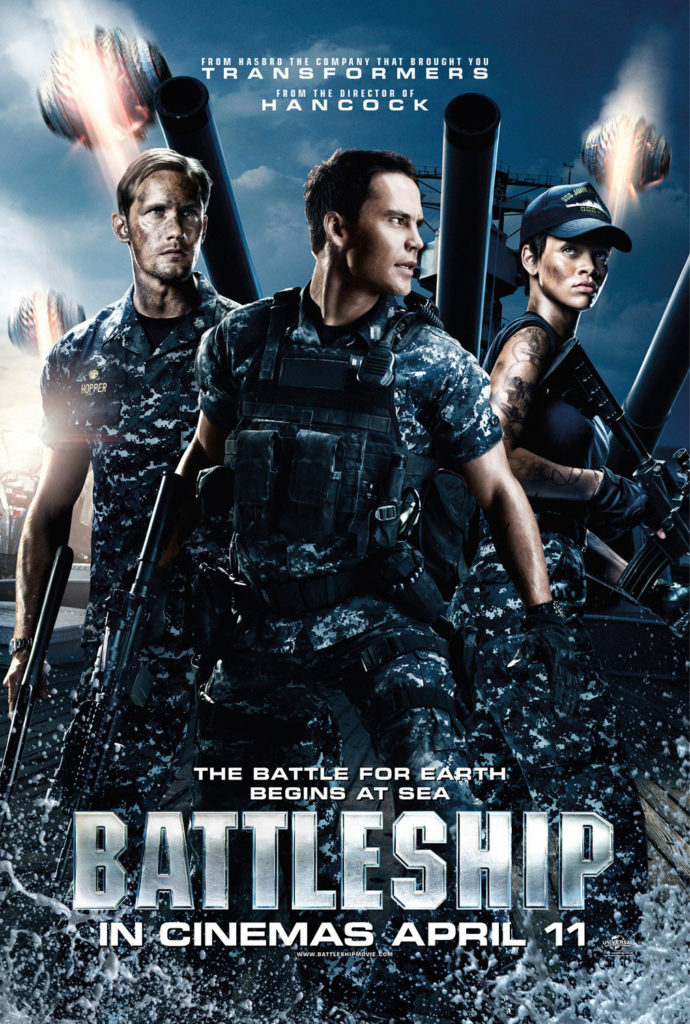 What a gloriously stupid movie. And I write that in a mean way. Battleship is the type of adrenalin-fuelled CGI monstrosity that assumes its audience didn’t pay attention in high school. From an introductory scene that will produce epic eye-rolling from Neil DeGrasse Tyson to a climax that demands we believe a museum ship can get underway at a moments notice AND carries live ammunition, Battleship requires the suspension of a lifetime of critical thinking skills in order to be enjoyed.
Directed by Peter Berg, Battleship is based on the classic Hasbro board game of the same name. That fact alone should be enough to make a viewer suspicious. There is now a decades-old pedigree of bad cinema based on video games, but at least the source material for those films had readymade narratives associated with them. Battleship is a board game. There is no narrative more complicated than tiny pieces of molded plastic. What a mountain the filmmakers raised for themselves.
According to the story, in 2005, scientists beamed a signal to an extrasolar planet that they believed harbored conditions ideal for life, hoping to contact an alien civilization. Meanwhile, the hero of the film, Alex Hopper (Taylor Kitsch), is a downtrodden sap celebrating his birthday with his successful older brother, Stone (Alexander Skarsgard), an officer in the United States Navy. Some idiotic shenanigans ensue as Hopper tries to impress Sam (Brooklyn Decker), a hot blonde who wants nothing more out of the night than to get her hands on a chicken burrito. Hopper is arrested for breaking and entering, and possibly resisting arrest, but is out of jail and nursing a hangover the next day as his brother issues a stern command for Hopper to sort his life out and join the Navy. Continue reading “Battleship”
Where Eagles Dare
Steven Spielberg once proclaimed 1968’s Where Eagles Dare his favorite war movie, partly because of its inherent unreality. One of the great movies of the, well, unrealistic era of war films, the great lesson of Where Eagles Dare is that when wielded by an American or a Brit, an MP-40 is the ultimate weapon of death. Continue reading “Where Eagles Dare”
The Foam Rubber Wholesalers Convention
 Christopher Nolan has wrapped up his epic interpretation of the Batman saga, and the viewing public has benefited greatly. After two of the most epic and well-made superhero films of all time, and fine films in their own right, the tale comes to an end this summer. Nolan, and his screenwriter brother Jonathan, should be credited with legitimizing and dragging into believability an aged franchise that at times wears its history and legacy as a seventy-year-old burden.
Only the most basic of continuity from the DC Comics characters remain in the Nolan retelling. Ra’s al Ghul? Dead after one film. Joker? One film and done (extenuating circumstances do apply). Two-Face? Dead, and a far cry from the criminal mastermind of the comics. Even Scarecrow, a stalwart of the Rogues Gallery, saw his menace pass with Batman Begins, settling for mere cameo in the subsequent films.
One of the things regular readers of the serialized Batman comics can count on is the lack of finality in any story. Sure, Joker, or Killer Croc, or Zsasz will wreak their havoc upon Gotham City and its inhabitants, but Batman always prevails, and Arkham Asylum welcomes the vanquished villain with open, inadequately secured arms, sure to let their ward escape to challenge the Masked Manhunter again...editors willing. Continue reading “The Foam Rubber Wholesalers Convention”
The Avengers, or, the War of the MacGuffin
Dictionary.com defines MacGuffin as “an object or event in a book or film that serves as the impetus for the plot.” Wikipedia goes further, defining it as “a plot device in the form of some goal, desired object, or other motivator that the protagonist (and sometimes the antagonist) is willing to do and sacrifice almost anything to pursue, often with little or no narrative explanation as to why it is considered so desirable (emphasis added).” Alfred Hitchcock is credited with popularizing the term in the movie industry, employing it himself, even turning Cary Grant into a MacGuffin in North by Northwest. Continue reading “The Avengers, or, the War of the MacGuffin”
The Grey
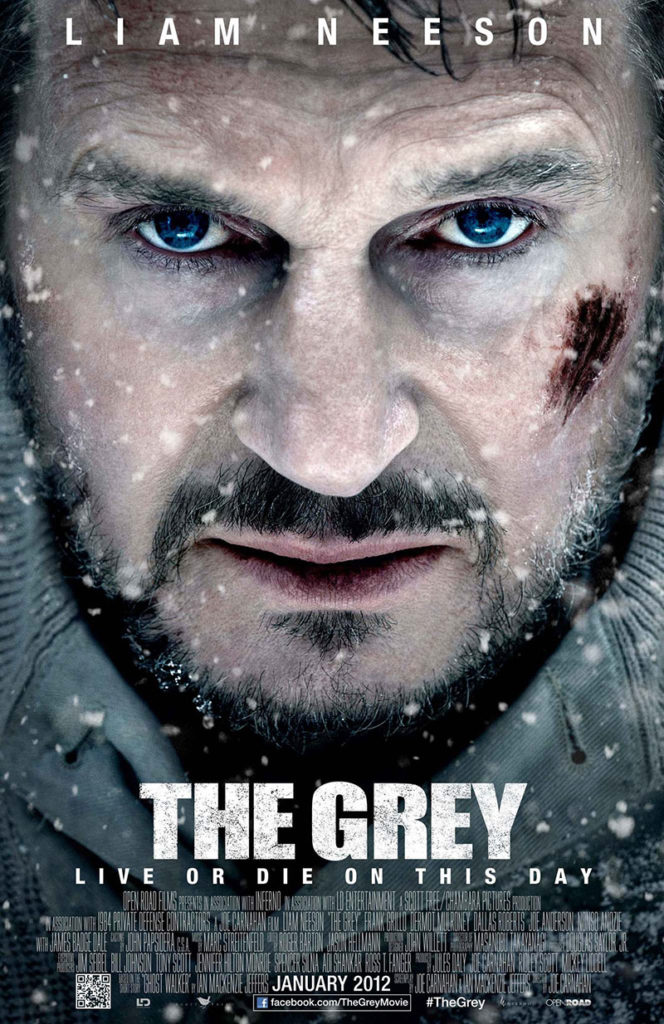 Man vs. nature, and by extension, man vs. his own nature. It’s not an uncommon theme in film. Usually it involves the breakdown of a group in an isolated environment, becoming feral, members desperately trying to maintain their humanity. Director and screenwriter Joe Carnahan’s The Grey dispenses with much of the metaphor and instead keeps things simple. Mere survival is the theme here, pitting a group of humans against a pack of wolves.
Set in the Alaskan wilderness, The Grey tells the story of a group of oil industry roughnecks who survive a plane crash on a mountain far away from civilization. Not long after the seven survivors organize themselves enough to get a life-saving fire burning, they discover they are being stalked by wolves. The wolves don’t seem to be interested in hunting the men for food. Rather, they seem intent on just killing them for being in the wrong place.
Led by the grim Ottway (Liam Neeson), a sniper employed by the oil company to protect the roughnecks from wolf attacks back at the camp the men originated from, the film follows the men as they try to escape from the wolves’ territory, their numbers whittled down throughout the course of the film. Continue reading “The Grey”
Predator
Predator is everything a 1980s action movie ought to be. It’s loud, overwrought, over-roided, and filled with cliché and blinding amounts of muzzle flash. All the characters are macho, carved out of wood, and traverse their fictional universe with names like Dutch! Dillion! Mac! Pancho! Blain! Hawkins! and...Billy. I’m surprised there wasn’t a character named ‘Duke’ in there somewhere. Oh, wait. Actor Bill Duke plays ‘Mac.’ Close enough. Continue reading “Predator”