
A million bucks must go a long way in Indonesia. That’s all the money writer/director Gareth Evans had on hand to film The Raid (released in the U.S. as The Raid: Redemption). Despite that tiny budget, Evans constructed a spectacular action flick, packed so full of visual and auditory stimuli that just watching it can make a viewer feel a little drained by the end. Continue reading “The Raid”
Tag: Cop Flick
The Offence
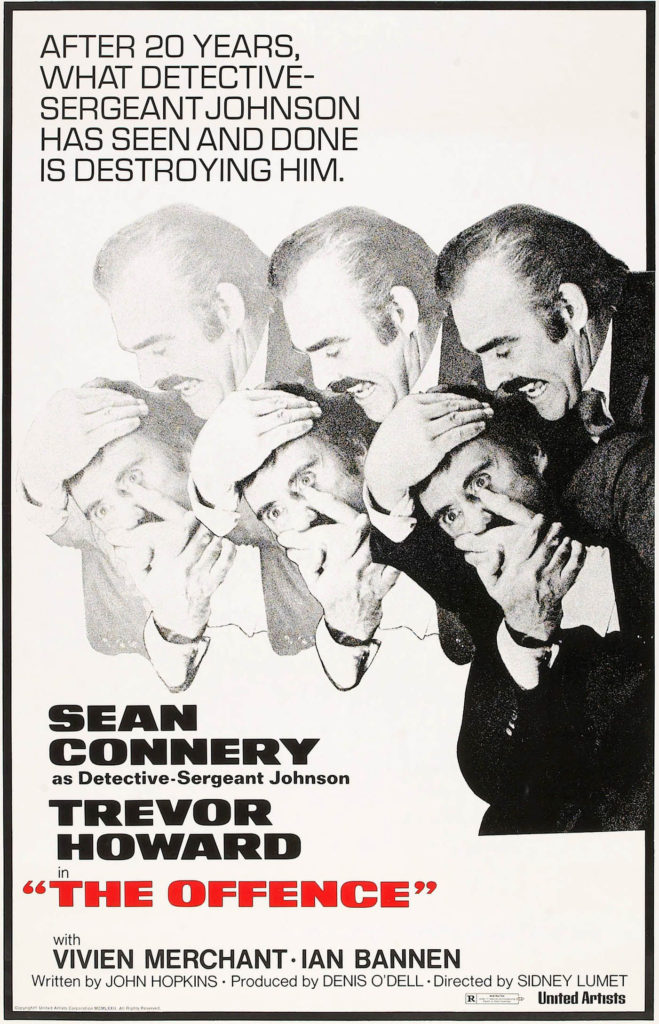 In the early 1970s, United Artists wanted Sean Connery back in the role of James Bond. Part of the deal that brought Connery back was UA agreeing to finance a pair of vanity projects for Connery, as long as the films didn’t cost much money. The Offence was the first of the pair, and the only one made.
From 1972, The Offence is an adaptation of the play This Story of Yours by John Hopkins. Hopkins was also brought aboard to pen the screenplay, with legendary director Sidney Lumet behind the camera.
In The Offence, Connery plays Detective Sergeant Johnson, a brutal, monster of a cop in England. Lately, the Sergeant and a team of detectives have been investigating the kidnappings and rapes of schoolchildren. The situation has gotten bad enough that Johnson and the others maintain a visual presence at a local school when it lets out, but that isn’t enough to prevent another young girl from being snatched. Later, as the police search nearby woods, it is Johnson who finds the young girl, terrified and laying in the mud, and who has to comfort her. This latest offense is just another in a litany of atrocities Johnson has witnessed in his 20 years as a police officer. His mind has been on the brink for some time, it appears, and after constables nab a suspect, Kenneth Baxter (Ian Bannen), Johnson snaps. During interrogation, Johnson beats the suspect to death, and has to account for his actions. Continue reading “The Offence”
Outland
Outland, the 1981 film written and directed by Peter Hyams, is two movies in one. Most of it is a crime story, heavy on the grit and with a fair amount of menace (helped along by Jerry Goldsmith’s grim score). Then in the final act audiences are given a western, evocative of the film High Noon. And all of it is wrapped in a sci-fi setting. Continue reading “Outland”
Alien Nation
There is a nasty amount of racial tension in America right now, accentuated by President-elect Trump’s impending inauguration next month. I hate that current events are affecting my perception of Alien Nation, the 1988 sci-fi film from director Graham Baker and screenwriter Rockne S. O’Bannon, but they are. Really, the filmmakers bear most of the blame, here. A huge part of the fictional universe Graham and O’Bannon crafted deals with refugees assimilating into American culture and having an effect, both positive and negative, on native demographics. Boy, I really need to find a way to flip off the politics switch in my brain when I’m watching movies. Continue reading “Alien Nation”
Last Action Hero
Is it an homage? Is it a parody? Last Action Hero is both. It is also a film whose idea was better than its execution. From 1993, Last Action Hero was released two years after Terminator 2. In the interregnum, Arnold directed a TV movie, Christmas in Connecticut (which I will NOT be watching), did a little voiceover work, became a restaurateur, appeared as himself in Dave (another film I’m choosing to skip), and slept on a mattress filled with Krugerrands. I’m not totally sure that last bit is true, as, sometimes, facts which we find on the internet turn out to be less than truthful. What I do know is that two years was an awful long time to wait for Arnold to build on the success of Terminator 2. I’m also not convinced that Arnold’s sabbatical from starring roles was unrelated to the decline of the American action star. Continue reading “Last Action Hero”
Kindergarten Cop
Sometimes, the toughest thing when writing about film is being impartial. Not every film a reviewer watches fits into their tastes or what moves them, but that does not mean a film is bad, or that it can be simply dismissed. The immediate, visceral reaction that one has to a film is only one factor that must be considered in deciding whether or not it is any good. For me, personally, there is no greater film kryptonite than a family flick. Even when I was a kid I could barely tolerate a family flick. Anything that tries so hard to be inoffensive, that so consciously tries to remove any edge or soul that is has, that appeals to the softest parts of all of us, is a whitewashing of the human experience, a greater fantasy than anything with dragons and orcs in it. Nobody, and I mean nobody, smiles as much as the suburban American zombies that inhabit family films. I don’t know why the idea of wholesomeness enrages me so much, but it always has, and it always will. Continue reading “Kindergarten Cop”
Red Heat
Most anyone who became aware of both self and American culture after the 1980s has heard of Arnold Schwarzenegger. They’ve probably seen at least one of his films, or maybe heard that he ran California and had terrible taste in SUVs. That’s not all these people would have in common. They would also all be collectively unaware that, once upon a time, Jim Belushi was famous. That’s right, Millennials and those from the generation-yet-to-be-adequately-named, once upon a time there was a mediocre actor and comedian who punched well above his weight, starring in such films as The Principal, Real Men, K-9, and Red Heat, all of which made money. Continue reading “Red Heat”
American Hustle
Five minutes into American Hustle, I realized I probably was not going to like the film. I stuck around for the next two hours, but the film never grabbed me. It has been praised by critics, but I consider myself kin to the many other viewers who left the film feeling apathetic. Us emotionless millions, unmoved by a film with such heavyweights, such ACTING — we are legion. Continue reading “American Hustle”
The Last Stand, or, Look! The New Chevys Are Out!
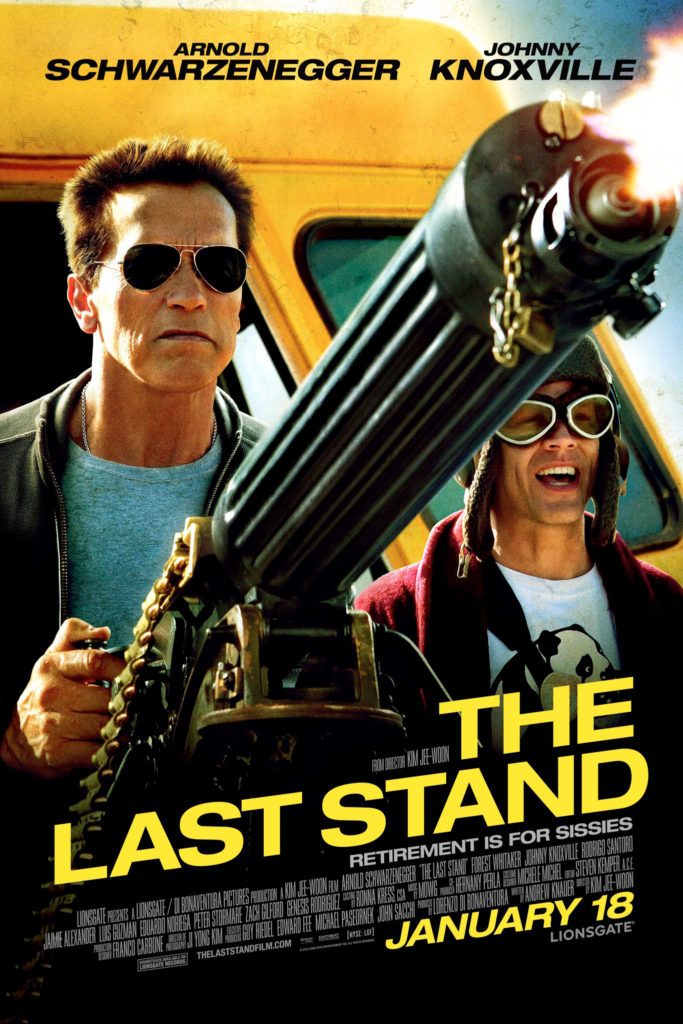 Arnold Schwarzenegger hasn’t starred in a movie in ten years, since Terminator 3. In The Last Stand, his first major foray onto the silver screen since he ended his time as governor of California, Arnold (normally I’d refer to a person by their last name in an article, but I’m not going to subject myself to typing out Arnold’s last name more than once) plays Ray Owens, the sheriff of a small border town in Arizona. He’s a former narcotics cop from the mean streets of Los Angeles, and the wistful gazes with which he paints his little town in the opening scenes are evidence that he prefers this life in small town America to the one he left behind in the LAPD. It’s either that, or Arnold was just thrilled to be back in a starring role. I can’t tell, but it’s easy to picture the film’s director, Kim Jee-Woon, instructing Arnold to express his real feelings of satisfaction at being back in the spotlight for these scenes, as getting Arnold to display any emotional range at all is more difficult than flying the space shuttle.
That’s not a knock on Arnold. Well, not much of one. After all, I never, not once, went into an Arnold Schwarzenegger (whoops, that’s two) flick expecting an Oscar worthy performance. Action flicks aren’t about nuance. They’re about violence and blowing shit up. Seeing Arnold in anything else is a waste of mine, and everybody else’s, time (I’m looking at you, Twins, Kindergarten Cop, Junior, and Jingle All the Way. In fact, I’m not looking at you. I’m going to pretend those films never happened, like Michael Jordan playing for the Wizards or Miles Davis coming out of retirement in 1981. My goodness, did I just equate Arnold Schwarzenegger [that’s three] to the greatest basketball player of all time and the greatest jazz musician of all time? Yes. Yes, I did. And you know what? That’s okay, because while Arnold is not the greatest actor of all time, he has a solid case for being the greatest action star of all time, and that has to count for something, right?). Continue reading “The Last Stand, or, Look! The New Chevys Are Out!”
Olympus Has Fallen
I’m heartened by the savviness shown by the audience members during a showing of Olympus Has Fallen this weekend. This was a crowd that was having none of director Antoine Fuqua’s shenanigans. It was clear from the moment the first commercials hit the airwaves that this film would be utter nonsense. It appeared that most of the people in the theater came with the knowledge they would be watching a total piece of shit, and they didn’t care. They were there for the shitty, for the schadenfreude, and for all the other reasons that bad movies entertain us. They were laughing and groaning in all the right places. It was my kind of crowd. Continue reading “Olympus Has Fallen”