Devil’s Express, aka Subway to Hell, aka Gang Wars

What a strange movie. Usually, when a film tries to be too many genres at once, the result is a jumbled mess that takes too many shortcuts, and is difficult to follow. That’s a good description of Devil’s Express (released under a number of other titles), the 1976 blaxploitation/martial arts/street gang/monster flick from director Barry Rosen, and screenwriters Rosen and Niki Patton. But, we like jumbled messes here at Shitty Movie Sundays. The closer a film comes to flying apart at the seams, the better. Continue reading “Devil’s Express, aka Subway to Hell, aka Gang Wars”

Split Second

Split Second, the 1992 flick from director Tony Maylam and screenwriter Gary Scott Thompson, has all the look and feel one would expect from low-budget Hollywood sci-fi schlock of the era. Everything is lit with colored gels, the film stock stinks, sets look cobbled together from whatever was piled out back behind the lumberyard, most location shots are dirty alleys, the original score is synthesized crap, and, in star Rutger Hauer, there is a fading Hollywood action flick veteran looking to pay some bills. In more ways than just this abbreviated list, Split Second is kin to the products of the Roger Corman gristmill, only this movie comes from England. Continue reading “Split Second”

Samurai Cop

Samurai Cop, the 1991 stinker from writer/director/producer/editor Amir Shervan, has more shitty filmmaking moments than are possible to recount in any review of reasonable length. Here’s a sample:

  • Fight scenes and car chases have sped up footage to simulate quickness. It’s not subtle, either — approaching Benny Hill Show levels of speed.
  • A great deal of dialogue was recorded in post. That’s not unusual. But Shervan did many of the voices himself, dubbing the voices of stars and bit players, alike. That is unusual.
  • There are a lot of cops in this flick. Many of them wear uniforms. Some of those uniforms don’t have badges.
  • Star Mathew Karedas cut his glorious locks after principal shooting wrapped, but was called back months later for reshoots. Shervan put a ridiculous wig on his head with little regard to whether or not it looked right. It does not look right. In at least one scene, it briefly popped off of Karedas’s head.

Continue reading “Samurai Cop”

Death Wish II

Forget for a moment that Death Wish II is one of the defining films for The Cannon Group and its producing pair of Menahem Golan and Yoram Globus. Forget that it was this film, along with Enter the Ninja, that would come to define a style of shamelessness that has brought endless amounts of joy to both the shitty movie fan and the wider action flick audience. Forget that a film like this scratches a primal itch that high culture would like to pretend doesn’t exist. Instead, revel in the fact that Jimmy Page did the music for this flick. That’s right. Jimmy Page. From Led Zeppelin. Continue reading “Death Wish II”

Truck Stop Women

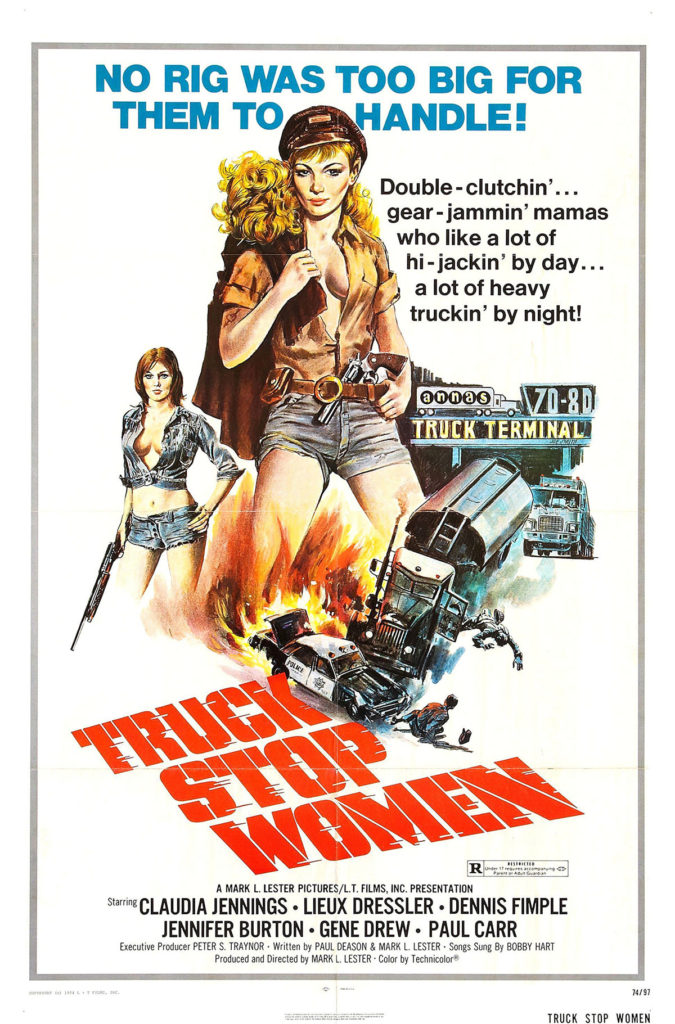
Truck Stop Women movie posterWhat a relentless pile of exploitative schlock. They don’t make them like this, anymore. The combination of online mob outrage, and the actual progressive growth of our morals, makes a flick like this a difficult proposition in the 21st century. Even watching this film, and a whole plethora of its contemporaries, can make a viewer feel a little squirrely, as if they were doing something wrong. This is one of those flicks that can make a person feel ashamed of being entertained. But, in for a penny, in for a pound. Truck Stop Women is wonderfully shitty.

From way back in 1974, Truck Stop Women tells the story of a truck stop/whorehouse in New Mexico, and its madam’s efforts to stave off mob competition. It’s a flick that wallows in its shittiness, from the low-rent country music soundtrack (all songs performed by Bobby Hart — my personal favorite track was Bullshippers), to its southern AND Italian stereotypes, to its bottom-of-the-barrel cast, and endless gratuitous nudity.

As gratuitous nudity goes, the nudity in this flick might be among the most gratuitous I’ve ever seen. Sure, much of the flick takes place in a whorehouse, and one would expect to see a few breasts here and there. But there’s a segment in this film that is basically a Bobby Hart music video montage, and some boob flashes made the cut. It’s the very definition of gratuitous, which dictionary.com has as “being without apparent reason, cause, or justification.” The breasts are everywhere, in all shapes and sizes. And they were glorious to behold. I write of the breasts not from some sanctimonious high ground, but because they are an essential and inescapable aspect of this shitty movie. There are so many bared breasts in this movie that a network TV cut would clock in at less than an hour. Continue reading “Truck Stop Women”

Chrome and Hot Leather

Chrome and Hot Leather walks and talks like drive-in outlaw biker gang flick, but it’s missing the two most important elements of true exploitation cinema: blood and nudity. It starts out promisingly enough, and, overall, it’s a quite enjoyable shitty movie watch, but it’s like a cake with no icing. It’s still good, but it wouldn’t be all that hard to make it better.

From way back in 1971, Chrome and Hot Leather was directed by Lee Frost, from a screenplay by Michael Haynes, David Neibel, and Don Tait. Whomever came up with the title isn’t listed in the credits, but that mysterious person certainly did more for this film’s longevity than anything that was captured on film. Perhaps it was producer Wes Bishop. No matter who is responsible, they did a nice job. Continue reading “Chrome and Hot Leather”

Triple Frontier

Netflix is in a battle with the Hollywood establishment. Hollywood patting itself on the back, in the form of endless awards shows in the winter, is more than just a glad-handing circle jerk. There is a lot of money at stake. Hollywood is a business, and the rules the establishment sets aren’t meant to maintain artistic integrity or anything else so noble. They are meant to protect the interests of the established players. The arcane rules of Hollywood state that a movie isn’t eligible for an award if it premiered in any other place than a movie theater. Should a movie premiere on something as ephemeral as the internet, it’s not a movie, apparently. That’s silly and stupid, and it’s only a matter of time before the powers that be are forced to reverse that decision. But the legitimacy of the movie theater is why Netflix, distributors of Triple Frontier, gave it a limited release in theaters before throwing it into their online catalogue. It doesn’t matter, though. If this flick gets nominated for any awards I’ll be shocked. Continue reading “Triple Frontier”

Bone Dry

We all have egos, right? There’s no use in pretending that we don’t. Personal and professional relationships can be thought of as a constant battle between our egos and our desire for successful interactions. In other words, not being a dick is learned behavior. I thought of this at the end of Bone Dry, a neo-noir flick released in 2007. That’s because right after the final shot of the film, the credits begin, and they read, “A Brett A. Hart Vision.” Oh, please. Continue reading “Bone Dry”

Walking Tall (1973)

Joe Don Baker is Buford Pusser, real-life Sheriff of McNairy County, Tennessee, in this violent drive-in classic from 1973. Directed by Phil Karlson, Walking Tall is the fictionalized account of one man’s war on crime in rural America.

After giving up his career as a wrestler and returning home with his wife, Pauline (Elizabeth Hartman), and kids to McNairy, Pusser finds that his home county has been invaded by organized crime. Gambling dens and houses of ill-repute have opened in the once-lazy locale, and Pusser doesn’t hold with any of that. After getting angry and trying to beat up an entire casino, Pusser is cut to ribbons and left for dead on the side of the road. But, the bad folks of McNairy underestimated Pusser’s resolve. Being almost murdered just made Pusser angrier, and he continues going after the criminal element. Continue reading “Walking Tall (1973)”

Caged Heat

Caged Heat movie posterWhat a piece of trash. I’ve written before that it’s folly to impose present morality on the past, and that includes living memory. But in this day and age, should someone try and make a film like Caged Heat, they might end up having to register as a sex offender. At the very least, Twitter would be apoplectic…for perhaps a week, before moving on to the next outrage.

From 1974, Caged Heat was future Oscar winner Jonathan Demme’s first foray in the director’s chair. Before this, he had written and produced a pair of exploitation flicks for Roger Corman and New World Pictures. This flick is also part of the Corman stable, although one won’t find his name in the credits. His fingerprints are all over it, though. From the gratuitous nudity that crosses over into crudity, to the pervading cheapness in fealty to ruthless cost-cutting, this is as much a Corman as a Demme flick.

Also written by Demme, Caged Heat follows the trials and tribulations of the inmates of the Connerville Correctional Institute for Women. Demme may have ‘written’ a ‘screenplay,’ but putting any effort into following the plot is a waste of time for the viewer. The story is just about the least important and engaging aspect of this flick. The purpose of this film was to make a quick buck by satisfying the more animalistic desires of its viewers. There is plenty of full-frontal nudity to satisfy all the young, teenaged boy’s desire for the female figure, should they not have had an older brother with a Penthouse stashed behind his headboard. I counted four(!) shower scenes. Of course, I’m writing of the past. The internet has made pseudo-smut like this unnecessary, and somewhat quaint. Continue reading “Caged Heat”