
The Japanese are the undisputed kings of weird. I’ve seen thousands of movies from scores of countries, and it is Japanese flicks that are the most consistently bizarre. The Japanese have a reputation as being a staid and conservative people, but when it comes to their art, they have outlets for their inner weird, and they take advantage of it.
From way back in 1977 comes House, a movie that does its best to defy description, but I’m going to give it a try. Picture a stage set fever dream with painted backdrops, bright colors, the aesthetic sensibility of a TV show made for toddlers, scenes reminiscent of NES-era Final Fantasy cutscenes, with music that sounds made for both hippies and long elevator rides. If that picture doesn’t resolve clearly in one’s head, that’s okay, no description of this film will. Take these lines from my notes:
- Kung Fu fights a chandelier
- Crazy kitty light fixture battle
As of this writing, I watched this movie less than fifteen hours ago and those notes are already approaching the nonsensical. Why do they both involve home lighting solutions? I don’t know!
Directed by Nobuhiko Obayashi from story elements conceived by his young daughter, Chigumi, and a screenplay by Chiho Katsura, House tells the tale of seven teenaged schoolgirls who travel to one of their aunt’s houses for summer break. As it turns out, something evil is happening in the house, and all sorts of deadly supernatural shenanigans occur.
The seven teens were played mostly by amateurs. The good news is, faults in their performances will be lost in translation for most viewers. All the characters have quirky names and matching character traits to make them stand out, almost like they are from some anime serial. There is Gorgeous (Kimiko Ikegami), who wears stylish clothes and 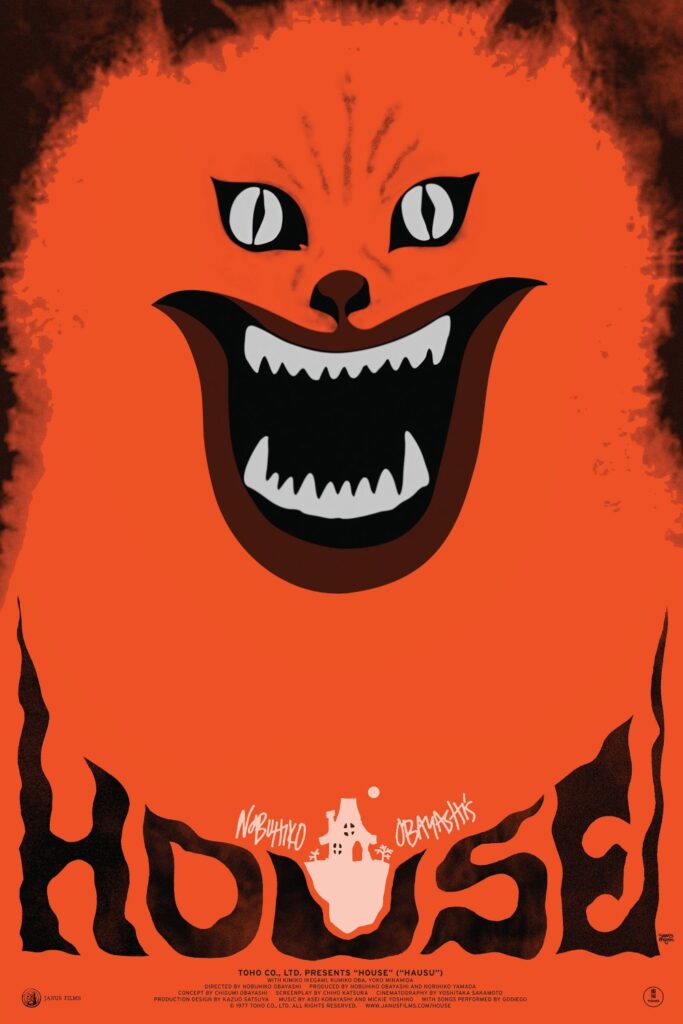 makeup; Fantasy (Kumiko Oba), who daydreams about future married life with one of her teachers(!); Prof (Ai Matsubara), who wears glasses and reads stuff; Melody (Eriko Tanaka), who can play music; Sweet (Masayo Miyako), who is sickly innocent; and Mac (Mieko Sato), who eats and suffers light bullying from the others for her bottomless appetite. Girls will be girls!
It’s Gorgeous’s Auntie Karei (Yoko Minamida) that they go visit. She has a history of tragedy. Her fiance was drafted into the army during World War Two, and he never came home. Auntie still holds a torch for her lost love, never finding another beau, and locking herself away in her house. She welcomes the girls with open arms, but it’s clear she has ulterior motives.
Things happen fast. By the time the girls arrive, this is already a strange movie, and Obayashi and company only make it stranger. The vast majority of shots were done on a soundstage, and Obayashi really turned the set designers loose. The house isn’t an unbelievable location, but its appearance has the feel of fantasy or a barely remembered dream. It also never pretends to be anything other than a set, in the same vein one might see at an opera house or Broadway show.
The girls are just as weird as anything else in this movie. There is no straight character. Every one of them pinballs off of events like they were born to them, no matter how far the situation strays from real life. As the house whittles them down one by one, they meet ends similar to their nicknames, yet Obayashi kept this from being too on the nose. There is still subtlety in this sledgehammer of a movie.
This painterly, stylized film never lets up from start to finish. The only criticism I have of its storytelling is that, like many Japanese films, it doesn’t know when to end. If there’s more than one way to end a movie, viewers can be sure that a Japanese filmmaker will tack it on as an epilogue, or two, or three. It never fails. The good news is, this flick only sticks around for about five minutes too long, and that’s a small price to pay for this raucous ride.
The style is weird, the setting is weird, the story is weird, the schoolgirls are weird. House is one weird movie worth seeing.