
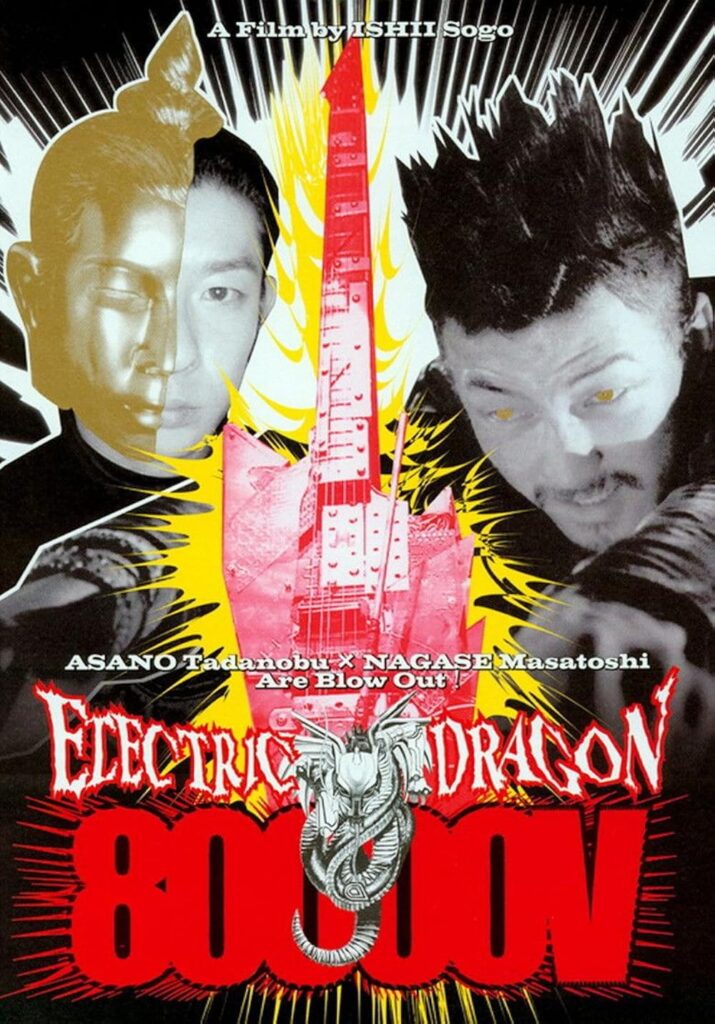
 Here at Missile Test, we love films with brevity. Keep it tight, don’t overstay one’s welcome, and try not to have multiple points after denouement when the credits could have begun to roll. We get it. Film is art, and artists have something to say. Cutting a film can feel like lopping limbs off of their own children. But there is little worse in film than having to sit through bloat. That won’t be a problem with Electric Dragon 80,000V, from Japanese filmmaker Gakuryu Ishii. This film clocks in at a brisk fifty-five minutes, and if a viewer can’t sit still for that long, it isn’t Ishii’s fault.
Dragon is one of those Japanese sci-fi flicks from the era (it was released in 2001) that relies on frenetic pace and cyberpunk visuals to tell the story. There is a story, but it’s peripheral to the visual dance of the movie.
Tadanobu Asano plays Dragon Eye Morrison, a young man whose violent tendencies were treated with electro-shock therapy, leaving him with superhuman abilities to throw electricity around. He finds inner peace by playing wild electric guitar, and spends his free time hunting down lost lizards in the back alleys and storm drains of urban Japan. This guy is the protagonist.
The antagonist is Thunderbolt Buddha, played by Masatoshi Nagase. He’s also gifted with the ability to wield electricity. He wears a shiny half-Buddha mask and spends his evenings hunting Yakuza. There isn’t any concrete reason why Dragon Eye and Thunderbolt should come into conflict, but they do, in a fight that could have come straight out of manga.
As noted above, Dragon lives on its visuals. Ishii and cinematographer Norimichi Kasamatsu chose black and white 35mm film as their medium, and the result is beautiful. High contrast or faded, the black and white shots that showcase the urban landscape of the film can at times approach the sublime. The concrete jungle isn’t supposed to look like this. Nature is nowhere in sight, and yet this film can evoke the same wistful yearnings as a landscape pic of an American national park.
But, that is mere background. The performances of the two leads is the dance. Asano bounds through the film like a coked up rock star, with the looks to boot. He is a solitary figure, wound very tight, and his pseudo-guitar playing is mastubatory, in both a self-abuse and therapeutic fashion. Meanwhile, Nagase channels any number of staid, mystical performances one could find in a martial arts flick. His look tells an audience that when he does explode, it will be epic.
Of course these two had to meet in the final act. How they get there would have mattered much more in a film with a typical running time. Since Ishii chose not to do that, the story is all shorthand. Get past the lack of narrative cohesion, and there is a film with incredible photography, and a hell of a lot of style.