
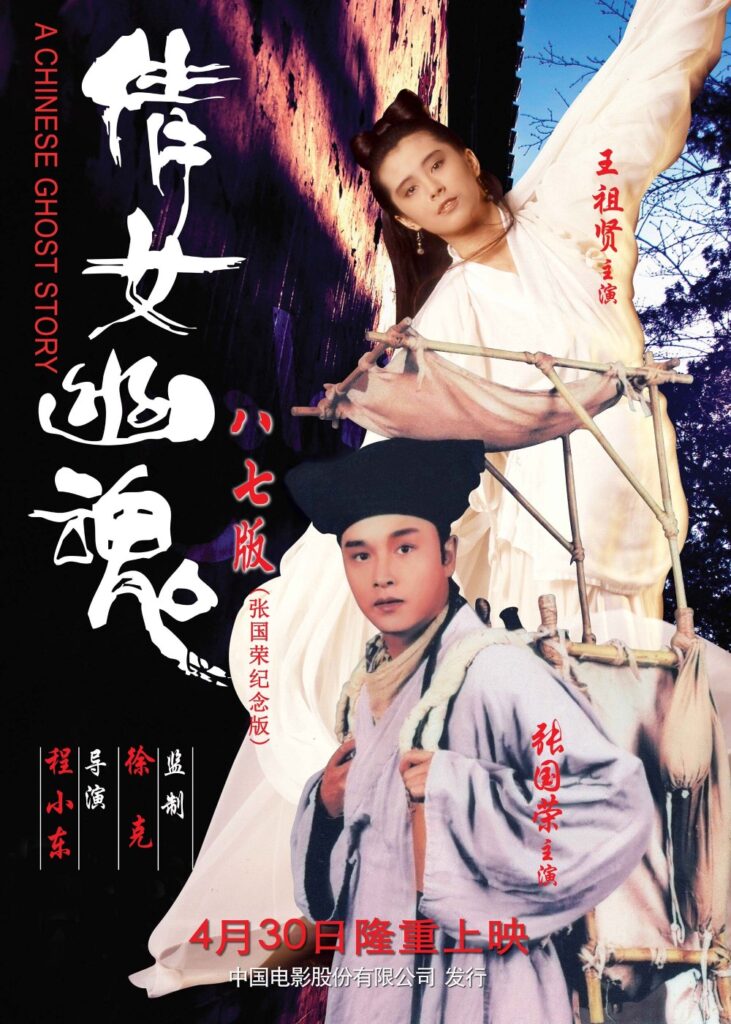
 A Chinese Ghost Story, from Hong Kong actor, stuntman, and filmmaker Siu-Ting Ching (screenplay by Songling Pu and Kai-Chi Yuen), is, according to the internet, a xianxia film. Xianxia are ‘closely related to the wuxia and shenmo genres.’ There is some cultural illiteracy here, on my part, but those strange new terms basically mean ‘based within Chinese mythology.’ Now we’re getting somewhere. If one has seen a Hong Kong martial arts flick that takes place before the emergence of modern China, one will be familiar with the look and feel of A Chinese Ghost Story. It’s a piece of fantasy, encompassing demons and the supernatural, with Hong Kong martial arts movie trickery thrown in, and comedy to keep things light.
The movie follows Leslie Cheung as Ling Choi San, a debt collector suffering from multiple slapstick maladies, who makes the mistake of spending a night in a haunted temple. There, he meets Yin Chek Ha (Wu Ma), a swordsman who retired from the civil service in disgust at the corruption, and now spends his time ridding the country of evil spirits. Yin Chek Ha is at the temple because it has recently been taken over by an evil tree demon (Siu-Ming Lau). All the inhabitants and caretakers have been killed and turned into stop motion zombies by the tree demon. It has also seized some recently deceased souls, which it uses to capture more innocent people to feed its insatiable appetite.
One of these souls is Lip Siu Sin (Joey Wong), who is this film’s resident damsel in distress. She, to her horror, is to be married off to another demon, but not if Ling Choi San has anything to say about it. He encounters the beautiful Siu Sin as she plays a zither in a pavilion, leaning into the porcelain doll nature of her character, and he’s hooked.
So, Yin Chek Ha wants to kill the ghosts and the demon at the temple, including Siu Sin, while Ling Choi San wants to free her, while he’s pretty ambivalent about the fate of the other specters. This leads to a final confrontation not just with the tree demon, but in the underworld. Veteran movie watchers will know where the ending is going before the final act, and it’s a satisfying one. The journey is where all the fun lives.
Siu-Ting Ching was a Hong Kong veteran by the time he helmed A Chinese Ghost Story. This was his third feature in the director’s chair, but he already had dozens of credits as a stuntman and actor to his name before this. He was well-versed in martial arts flicks, and it shows. The fight choreography in this flick is tight, and just as fantastical as other contemporaries. Fighters defy physics as they fly around and leap up to balconies from the ground. Everything is fast, frenetic, and skillful.
The horror elements are wonderful, especially the zombified temple dwellers. They don’t appear much on screen, and when they do they are an ineffectual threat to the protagonists, but have an absurd humor to them that fits nicely with the overall tone of the film. The other ghosts and demons are elaborately costumed actors, and it’s their look and mannerisms that are the strongest mythological element to the movie. Zombies are a universal cinematic experience, while the mythological elements make this feel like something new to this western-oriented amateur film critic.
All of this is wrapped in levity. This isn’t what I would call a comedy movie, but the comedy is pervasive. It’s used to keep a very dark story lighthearted. Without the comedy, the martial arts exaggerations and the zombies would seem totally out of place. The comedy is not the purpose of the film, but it binds it all together.
A Chinese Ghost Story is not a grandiose period piece. Siu-Ting Ching kept things small and tight, telling a good story (while skewering political corruption), and making it seem as if his primary focus was entertaining the audience. Good for him, and good for us. A Chinese Ghost Story is a fine addition to anyone’s October horror movie viewing.